How to Sell on Xiaohongshu: Do You Need a Store, and Which Route Fits (2026)
TLDR
First question first: many foreign brands should not open a Xiaohongshu store yet, because content and creator seeding can carry the first phase while demand gets proven. When you do sell, three routes exist: the cross-border store (no Chinese company needed, but the 2026 rules require a designated domestic responsible person), a domestic store through a Chinese entity, or a TP partner operating on your behalf. Money at a glance: deposits run 5,000 to 50,000 RMB by category, the base technical service fee sits around 5% (up to about 10% for some categories), import tax adds 9.1 to 23.1%, and none of it produces sales without a continuous note-and-livestream engine feeding the store.
"How to sell on Xiaohongshu" is really two questions wearing one query: should you, and which way. The step-by-step store screens are documented elsewhere; what foreign brands actually lack is the decision layer, because the expensive mistakes (wrong route, gated category, deposit math that never worked) all happen before the application. That layer is this page. We run these feasibility calls weekly, and the structure below is the one we use.
Want the feasibility call made with real numbers? Our ecommerce team scopes it.
Do you need a Xiaohongshu store yet?
Open the store when demand signals exist and the unit economics clear the fees; start content-first when they don't. The decision tree we run:
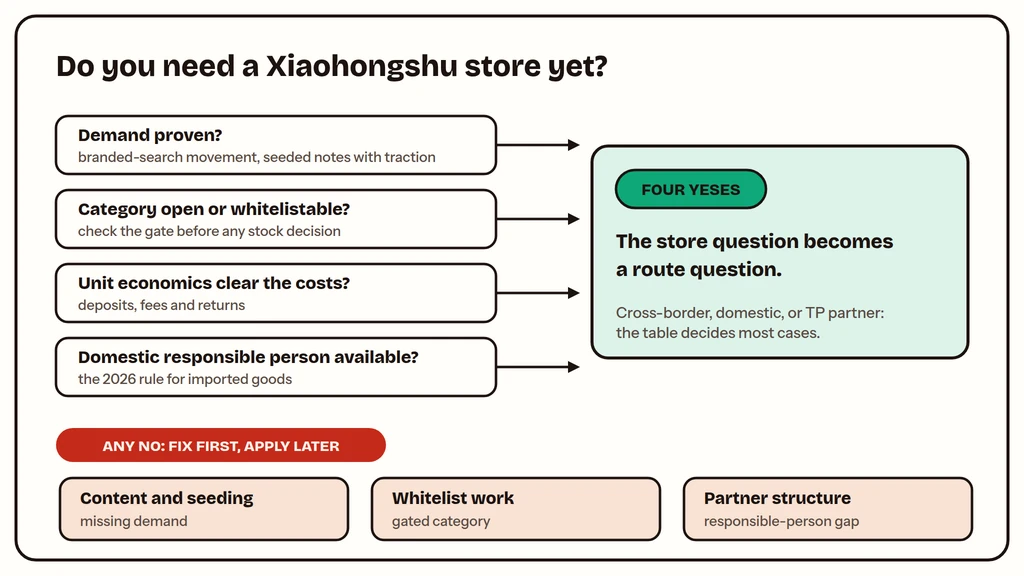
Demand proven (branded-search movement, seeded notes with traction)? Category open or whitelistable? Unit economics clearing deposits, fees and returns? A domestic responsible person available? Four yeses and the store question becomes a route question. Any no routes you to a fix-first lane: content and seeding for missing demand [see our marketing guide], whitelist work for gated categories, and partner structures for the responsible-person gap.
Food-truck logic applies here. Restaurant operators park the truck on the street and count the queue before signing a lease, because the lease is the expensive, fixed, hard-to-exit commitment. On Xiaohongshu, the store is the lease and content-first is the truck: seeding notes and creator deals test demand for a fraction of the deposit-plus-operations commitment, and the search data tells you when the queue exists. Opening the store first inverts the sequence and pays fixed costs to wait.
One lane deserves naming (the "not eligible yet" lane): brands missing the trademark chain, the responsible party, or category approval aren't blocked forever, they're sequenced: fix the gate, run content meanwhile, apply when the file is real.
Category and unit-economics fit
Category decides twice: whether demand exists, and whether entry is even open. The strongholds, per 2026 first-half category data: beauty and personal care, mother-baby, supplements, and apparel/shoes/bags. The bind is that several of those same categories are whitelist-gated (报白) for cross-border sellers, so strong fit and gated entry coexist, and checking the gate comes before any stock decision.
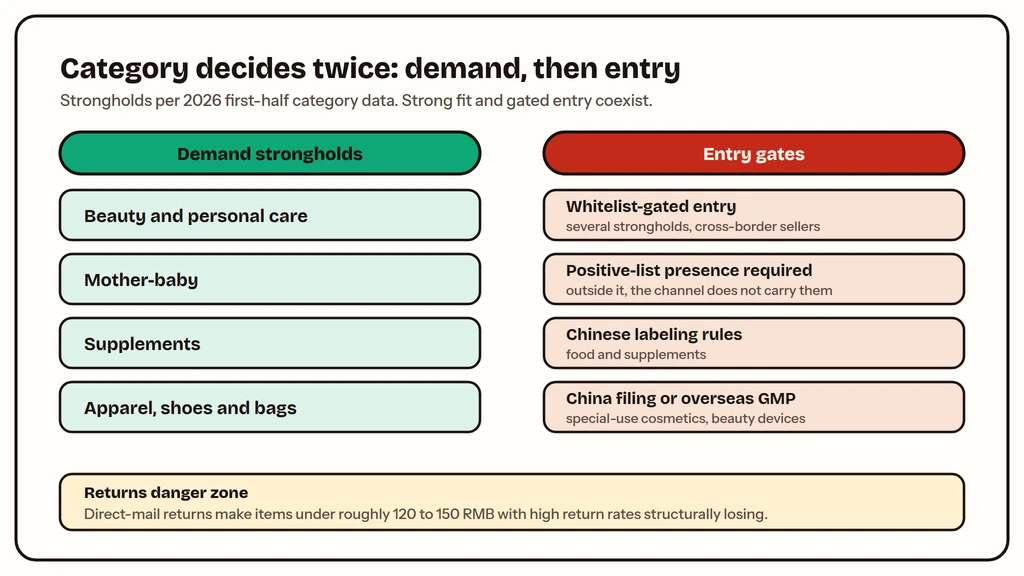
Three harder gates behind the obvious one. Goods must appear on China's cross-border retail import positive list at all: outside it, the channel simply doesn't carry them, and food and supplements must also satisfy Chinese labeling rules. Special-use cosmetics and beauty devices typically need China filing evidence or overseas GMP certification for their whitelist, approvals that run months and have sunk more launch windows than any marketing mistake. And unit economics gate the rest: direct-mail returns make items under roughly 120 to 150 RMB with high return rates a structurally losing category, whatever the demand looks like.
Our read after enough of these calls: category fit plus unit price above the returns danger zone predicts store success better than brand size does. Big brands with wrong-priced catalogs lose to small brands with right-priced ones, reliably.
The three routes compared
The table decides most cases:
| Cross-border store | Domestic store | TP partner | |
|---|---|---|---|
| Entity required | Overseas company (incl. HK/MO/TW) | Chinese entity (WFOE or partner) | Partner's entity operates |
| Deposit shape | 5,000-50,000 RMB by category | Domestic schedule, from 1,000 RMB | Inside the partner agreement |
| Time to launch | Weeks, plus whitelist time if gated | Months (entity first) | Fastest once contracted |
| Fulfilment | Bonded warehouse or direct mail | Domestic logistics | Partner-run, usually bonded |
| Responsible person | Required for imports (2026) | The entity itself | Partner fills the role |
| You own / partner controls | You own store + operations | You own everything, and the entity | You keep trademark, brand account, strategy; partner runs store ops, often the payment chain |
| Pick it when | No CN entity, category open, ops capacity exists | Long-term China commitment already made | Gated category, no responsible person, or speed beats margin |
Three route notes with money attached. The cross-border route carries the 2026 mandate: under the April 2026 customs policy and the platform's onboarding rules (updated March 2026), imported-goods sellers designate a domestic responsible person, a Chinese company or individual carrying consumer-protection and customs joint liability; TP partners and affiliated companies fill the role, and the full application detail lives in our cross-border store guide. The domestic route is not a workaround: foreign investment sits behind the negative-list regime, meaning a WFOE or local partner, months of setup, and a commitment that should exist for reasons bigger than one storefront. The TP route trades margin for operation and solves the responsible-person gate in the same contract; it's also reversible in principle, though moving from TP to your own entity later means re-filing the store, so decide the asset-ownership question in the first contract, not the exit.
Prerequisites and the setup journey
Whichever route wins, the account layer comes first and the order doesn't bend: verified professional account, claimed brand, then the route-specific file.
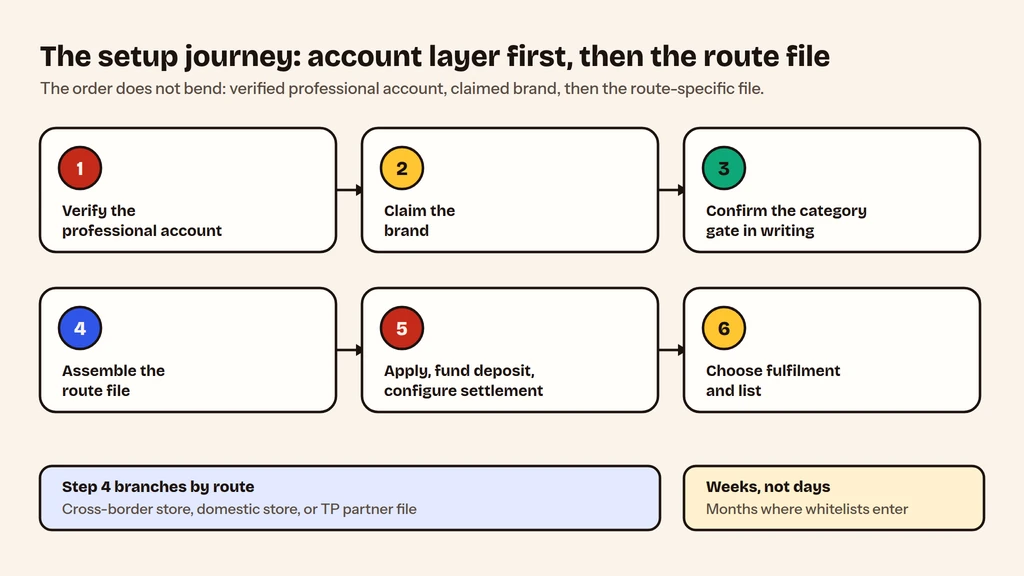
- Verify the professional account: the overseas process, documents and hidden prerequisites are in our verification guide.
- Claim the brand: same trademark chain, and it protects the brand zone while the commerce application advertises your name.
- Confirm the category gate in writing (whitelist status, positive-list presence).
- Assemble the route file: entity documents, trademark chain, responsible-person authorization where required.
- Apply, fund the deposit, configure settlement.
- Choose fulfilment and list.
Time expectations, hedged because review windows shift: weeks, not days, for the full chain, and months where whitelists or entity formation enter. The clock argument for starting the account layer now, whatever the store decision: everything on it is reusable and nothing about it commits you to selling.
Costs and margins overview
The strip, all dated to the 2026 handbook via practitioner review; confirm current values at application.
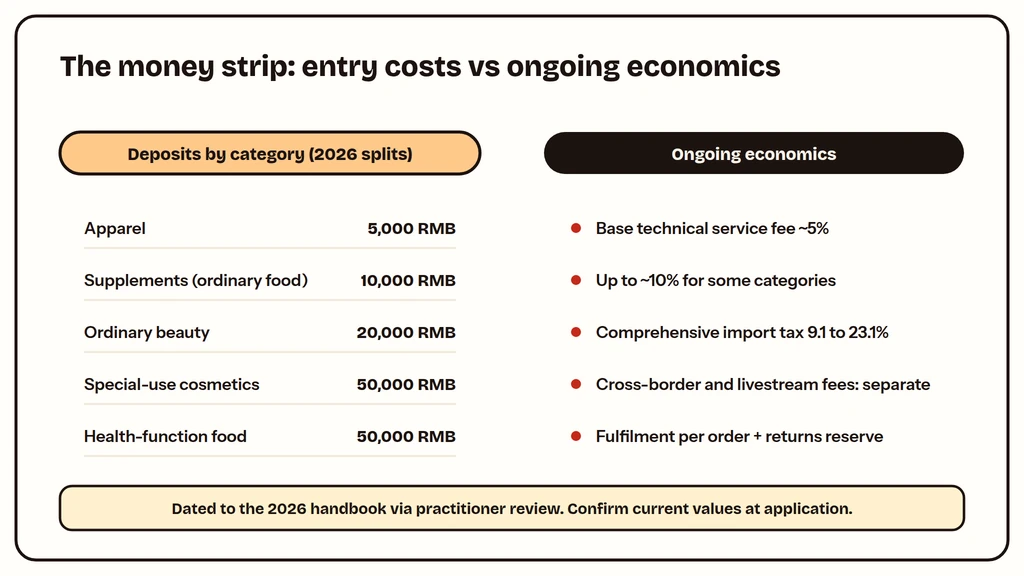
Entry costs (one-time or refundable): deposits by category, with 2026 splits worth knowing: ordinary beauty 20,000 RMB but special-use cosmetics 50,000; apparel 5,000; supplements 10,000 as ordinary food, 50,000 as health-function food. Ongoing economics: base technical service fee about 5%, up to roughly 10% for some categories, with cross-border and livestream fees as separate line items; comprehensive import tax 9.1 to 23.1% by category; fulfilment per order; and a returns reserve that direct-mail sellers underestimate at their peril.
The margin sanity check we run before any application: take your unit price, subtract commission, tax, fulfilment and the returns reserve, then ask what monthly volume justifies the deposit sitting locked. A 50 RMB item at 12% commission with a 10,000 RMB deposit needs roughly 83,000 RMB in monthly sales before the lockup stops dominating the P&L; the full worked math lives on the cross-border page. If the number looks absurd against your realistic volume, the tree in section one just answered itself.
Fulfilment, returns and the livestream reality
Fulfilment in one screen: bonded warehouses buy speed and in-country returns at the price of stock commitment; direct mail buys catalog breadth and low commitment at the price of the returns trap, where a returned parcel ships back overseas at freight that can exceed item value. The full comparison, returns column included, is on the cross-border page.
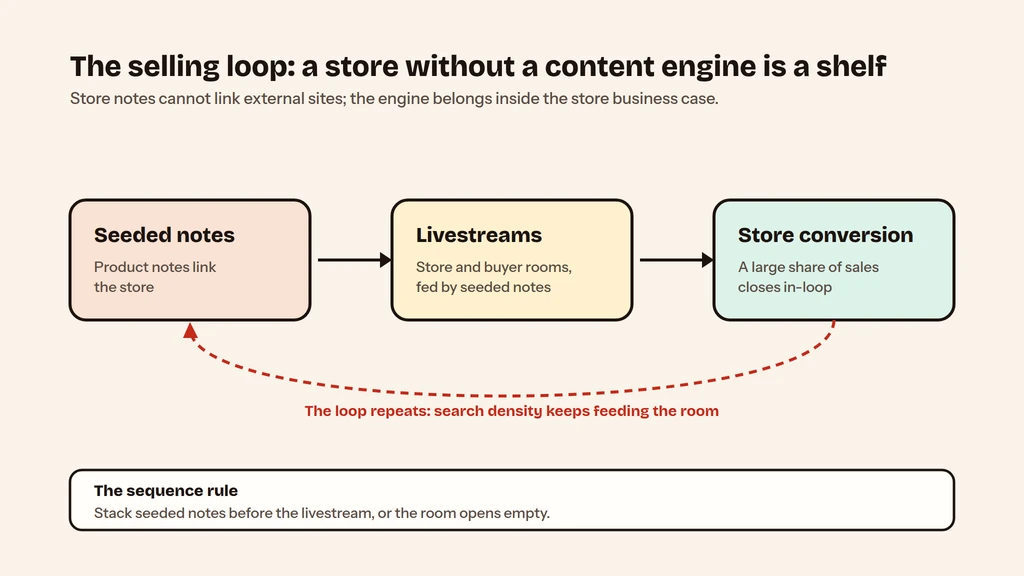
The traffic reality belongs in the selling decision, not the marketing appendix: store notes can't link external sites, product notes link the store, and current cross-border stores close a large share of sales through store and buyer livestreams fed by seeded notes. The operating consequence is a sequence: stack seeded notes before the livestream or the room opens empty. A store without a content engine is a shelf in a closed room, and budgeting the engine (notes, creators, paid amplification) belongs inside the store business case, not next to it.
Five common roadblocks (and their fixes)
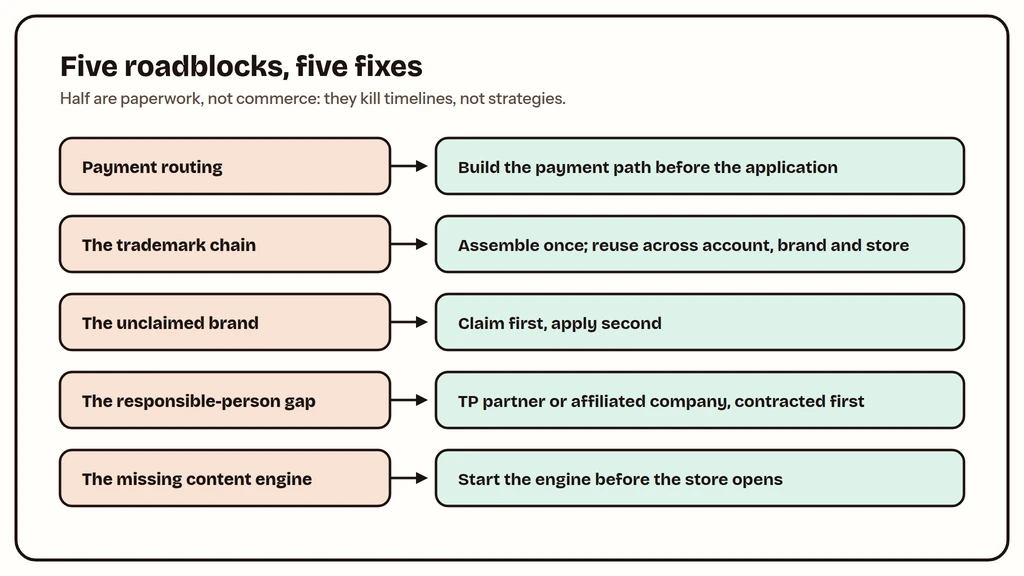
- Payment routing. Foreign cards and bank accounts don't plug in directly; settlement and funding run through licensed processors. Fix: build the payment path before the application, not during.
- The trademark chain. Every link from rights holder to operator, or the file stalls. Fix: assemble it once, correctly; it reuses across account, brand and store.
- The unclaimed brand. Applying for commerce with an unclaimed brand invites squatting at the worst moment. Fix: claim first, apply second.
- The responsible-person gap. Pure-overseas brands hit the 2026 wall at filing. Fix: TP partner or affiliated company, contracted before the application.
- The missing content engine. A live store with no note flow flatlines. Fix: the engine starts before the store opens, per the sequence above.
Half of these are paperwork rather than commerce, which is the encouraging part: they kill timelines, not strategies, and every one is solvable before it costs anything. That, plus the route call and the margin math, is what our ecommerce agency service does in its first engagement.
We can help
If the tree said "not yet," we'll build the content-first phase that gets you to yes with data. If it said "store," we'll make the route call with the category ruling in writing, the responsible-person role covered, and the margin model built on your actual price points. Ask for a selling feasibility check: a yes, a no, or a cheaper sequence, each with numbers attached.
FAQ: selling on Xiaohongshu
How long does store approval usually take?
With a clean file, weeks; add whitelist processing (months for gated categories) and entity formation where relevant. The account and claiming layer in front of it is days, which is why it starts first.
Can a brand switch from a TP model to its own entity later?
Yes, and brands do once China revenue justifies the structure. Plan the switch in the first TP contract: store-asset ownership, data handover and the re-filing path decide how painful it is.
Who handles returns in the cross-border model?
The platform process fronts the customer; the cost lands on the seller. Bonded stock returns in-country; direct-mail returns ship overseas or get destroyed, which is why the returns reserve sits in the cost strip.
Can one store sell multiple trademarks?
Yes, with a complete authorization chain per brand and the right store format. Map the brand-to-store architecture before filing; restructuring after is the expensive version.
Should we open on Xiaohongshu or Tmall first?
Different jobs: Tmall is shelf and search for demand that exists; Xiaohongshu builds the demand and closes it in-loop. Brands with proven China demand often run both; brands still proving it usually start where the proving happens.