Xiaohongshu Marketing: How Foreign Brands Win on RedNote (2026)
TLDR
Xiaohongshu marketing works for consumer brands in categories Chinese buyers research socially before purchasing: beauty, fashion, food and drink, lifestyle, mother-baby. It's a weak fit for heavy B2B and low-consideration commodity. The operating model runs four levers in sequence: organic notes prove the message, creator seeding scales the proof, Juguang ads scale the winners, and commerce closes. A realistic first six months costs 50,000 to 150,000 RMB all-in depending on content volume, meaningful validation takes about that long, and a store is not required to start; it usually shouldn't come first.
The platform Western coverage still calls "China's Instagram" is closer to a purchase-research engine with a social interface: 320 million monthly users as of June 2026 (company-reported), with roughly 60% of them touching search (QuestMobile, 2026). Brands that treat it like a social channel run campaigns at it; brands that understand the research behavior build an operating system on it. This is the operating guide: who the platform fits, how demand actually forms, the four levers and their sequence, a first-six-months plan with decision gates, and the budget and KPI structure to run it. Every lever links to its full guide one level down; this page is how they fit together.
Want the six-month plan built for your brand? Talk to our Xiaohongshu team.
Is Xiaohongshu right for your brand?
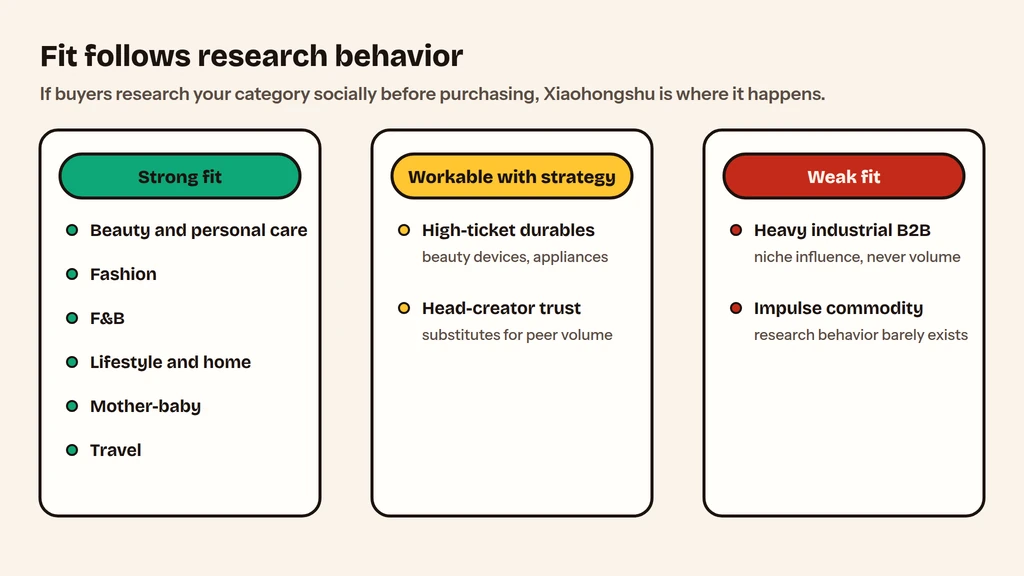
Fit follows research behavior: if buyers research your category socially before purchasing, Xiaohongshu is where that research happens; if they don't, no budget fixes the mismatch. Strong fit: beauty and personal care, fashion, F&B, lifestyle and home, mother-baby, travel. Workable with strategy: high-ticket durables (beauty devices, appliances), where head-creator trust substitutes for peer volume. Weak fit: heavy industrial B2B, where a niche expert account can build precise small-scale influence for brand purposes but will never produce volume, and impulse commodity, where research behavior barely exists.
One platform rule bends every brand plan here: trust is built on utility, not fame. Michelin understood this in 1900: a tire company published a free, relentlessly useful guide to get France driving, and the usefulness bought the brand an authority a century of advertising couldn't have. On Xiaohongshu the same trade is mandatory. Brands earn standing by being useful in notes (what works, for whom, with what caveat) before image campaigns land on anything. Western teams that open with a brand campaign are speaking before the platform has given them the microphone.
The other fit question is channel order. Against Douyin, the shorthand we give clients: Xiaohongshu is the research-and-trust engine, Douyin is the impulse-and-entertainment engine. Products bought after comparison start on RED; products bought in the moment of seeing them start on Douyin; most consumer brands eventually run both, in that order, because trust built on RED lowers acquisition cost everywhere else, including Tmall search. The practical test when a client insists on choosing one: search your category on both platforms and read what users do there. Comparison threads and saved collections point to RED first; duet trends and live-room impulse point to Douyin first. The user behavior answers the channel question better than any agency deck.
How demand forms: feed, search and zhongcao
Demand forms in a loop with three stations. Notes seed interest in the feed, where discovery happens. Users carry half-formed intent into search, where the platform's own commercial team reported 40 to 50% of sessions starting as of its 2025 trend report. And search now closes: results carry direct product cards, so a user can move from query to purchase without leaving the results page, which tightened the in-app loop again.
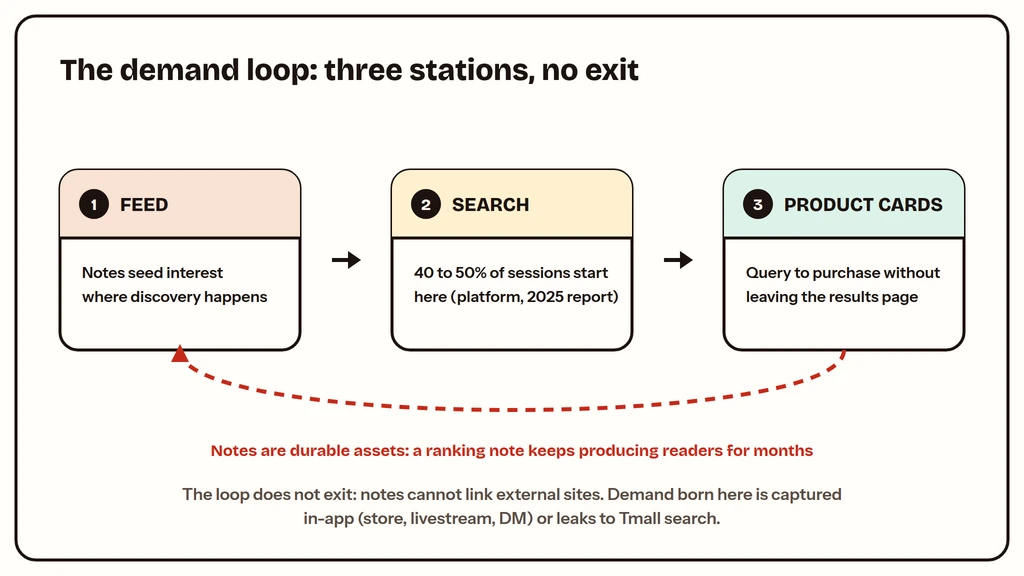
Two properties of this loop decide strategy. First, notes are durable assets: a note ranking for a category search keeps producing readers and buyers for months, which is why patient content beats campaign bursts here and why seeding budgets compound instead of expiring. Second, the loop does not exit: notes can't link external sites, so the DTC funnel Western teams default to (social spark, owned-site conversion) structurally doesn't exist. Demand born on Xiaohongshu is captured on Xiaohongshu, in store, livestream or DM, or it leaks to Tmall search where you'd better also be present.
Zhongcao (种草, "seeding") is the behavior underneath all of it: users planting purchase intent in each other through experience notes. It is not product placement; a seeded note carries real-experience texture and information value, or the audience and the algorithm both discount it. That distinction, covered properly in our influencer marketing guide, is the single most common thing Western creative gets wrong.
The operating model: four levers, one sequence
The levers are sequential capabilities, not a menu. Organic proves the message, creators scale the proof, ads scale the winners, commerce closes what demand exists. Run out of order, each lever gets more expensive; run in order, each one de-risks the next.
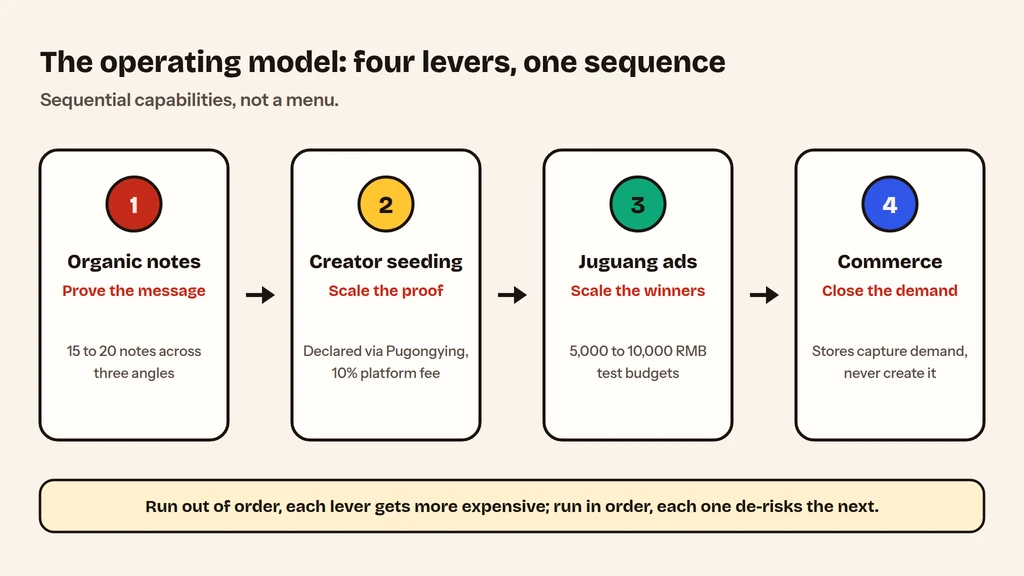
Organic notes. The brand account's own content, and the cheapest message laboratory you'll ever run. The infrastructure beneath it (verified professional account, claimed brand) is covered in the prerequisites section; the discipline on top of it is banned-word compliance (no superlatives, no efficacy claims) and a publishing cadence the team can hold. What organic is for, strategically: testing message angles at near-zero media cost and building the note bank that search will eventually reward. Fifteen to twenty notes across three angles tells you which message deserves creator money, and that answer is worth more than the notes themselves.
Creator seeding. The scale layer for whatever organic proved. KOC-heavy waves for low-consideration categories, head-creator anchors where price demands trust, all of it declared through Pugongying with a 10% platform service fee (before tax). The strategy, campaign models and the seven-stage workflow live in the influencer guide; the money, tiers and worked scenarios in the KOL cost breakdown. The planning fact worth repeating at this altitude: creator notes are the same durable search assets as organic ones, at scale.
Juguang ads. The amplifier, and deliberately third. Paid works here when it scales proven content: creative quality sets effective CPC on the platform (weak creative gets throttled into expensive irrelevance), so ads run before message proof burn budget learning what organic would have taught cheaper. Feed and search placements from 5,000 to 10,000 RMB test budgets; the platform mechanics in the advertising guide, the rates and worked budgets in the cost breakdown.
Commerce. The closer, and last on purpose. Store routes for foreign brands, deposits, and the do-you-need-it-yet decision live in the selling guide; the operating rule at this altitude is that stores capture demand and never create it, and livestream (fed by seeded notes) is how current stores actually close.
The rule that binds the levers: run them as one data loop. Winning creator notes get amplified through Juguang heating; ad data feeds back into which creators get re-booked; store conversion tells the content team which angles sell rather than merely engage. The most expensive habit in the market is running creators and ads as separate line items with separate agencies and no shared winners, and it's common enough that we list it under mistakes below. Where the model bends: impulse-priced products can sometimes skip seeding straight to ads, and B2B-adjacent brands may stop at levers one and two entirely.
The first six months: the operating plan
Six months, three stages, and a decision gate at each exit. This calendar is the spine the levers hang on.
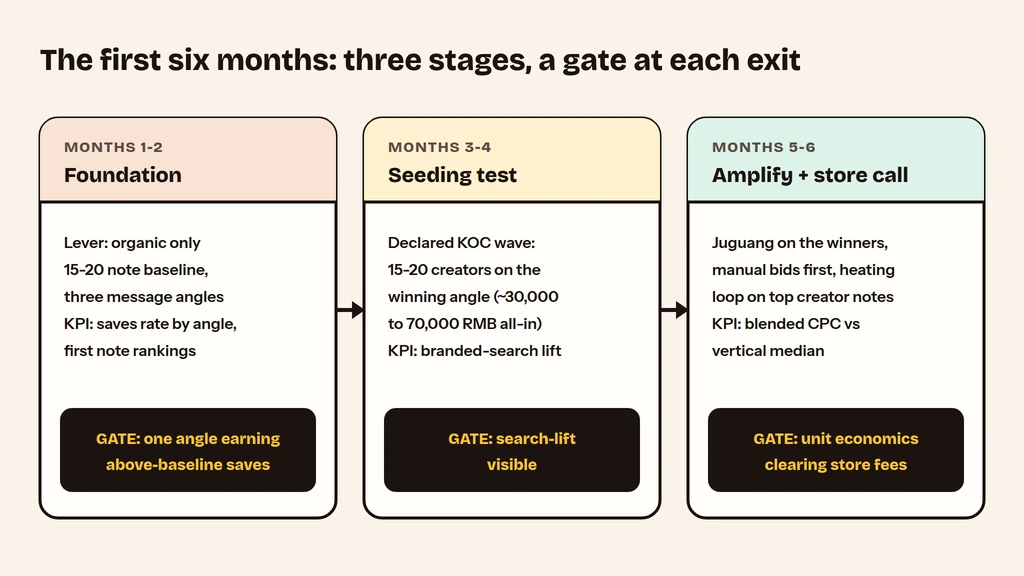
Months 1-2: Foundation. Objective: infrastructure and message testing. Assets: verified account, claimed brand, and a 15-20 note baseline across three message angles. Lever: organic only. Budget share: content production. KPI: saves rate by angle, first note rankings. Gate: at least one angle earning above-baseline saves. Pass, and creators scale it; fail, and you revise the message for the price of some notes, which is the entire point of sequencing.
Months 3-4: Seeding test. Objective: scaled proof. Assets: a vetted creator shortlist and compliant briefs (the finding process). Lever: a declared KOC wave, 15-20 creators on the winning angle. Budget share: the seeding test, roughly 30,000 to 70,000 RMB all-in at this stage's scale (scenario detail). KPI: engagement quality and branded-search lift, the metric this stage exists to move. Gate: search-lift visible, amplify; flat, revise the message or the creator mix before spending more, because flat search after twenty declared notes is a message problem, not a media problem.
Months 5-6: Amplify and decide commerce. Objective: efficient scale and the store call. Assets: a proven creative bank from stages one and two. Levers: Juguang on the winners, manual bids first, the heating loop on top creator notes, search campaigns on brand and category terms (budget structure). KPI: blended CPC against your vertical's median, plus conversion events once tracking is wired. Gate: unit economics clearing store fees per the selling tree, apply; not yet, stay content-first and let the compounding notes keep working. A store opened in month one is a shelf in a closed room; by month six you know whether the room has a queue.
One operating risk runs across all six months: remote teams miss cultural moments. Trend-sensitive content run from another timezone drifts out of register fast, so the model assumes either a local team, an agency, or serious trend tooling in the loop; that's an operating cost, not an optional extra.
Budget bands and what each buys
A credible first six months runs 50,000 to 150,000 RMB all-in, and the spread is mostly content volume and creator count. The bands, with what each actually buys:
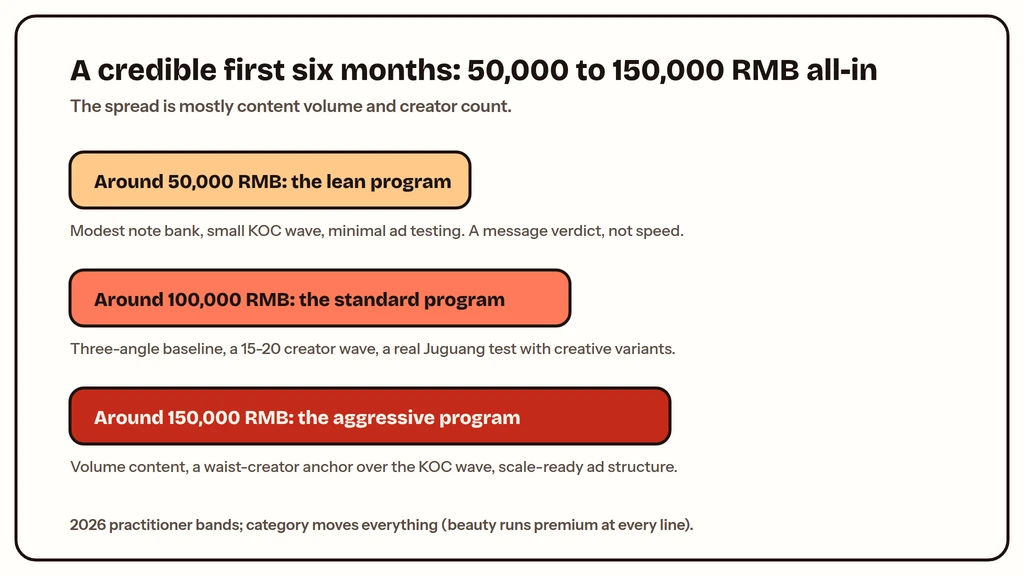
Around 50,000 RMB: the lean program. A modest note bank (localized production is the quiet cost: 1,500 to 3,000 RMB per image-text piece, 3,000 to 8,000 per video), a small KOC wave, minimal ad testing. Buys a message verdict and first search presence; doesn't buy speed. Around 100,000: the standard program. The full calendar above: three-angle baseline, a 15-20 creator wave, a real Juguang test with enough creative variants to mean something. Around 150,000: the aggressive program. Volume content, a waist-creator anchor over the KOC wave, scale-ready ad structure. Figures are 2026 practitioner bands; component detail lives on the three cost pages, and category moves everything (beauty runs premium at every line).
Set the ROI expectation with the budget, not after it: in-app closed-loop ROI commonly lands between 0.8 and 2.0 by category (2026 practitioner data), and the long-effect return shows up in off-platform search and repeat purchase over quarters. Judge six months on branded-search movement plus closed-loop, and treat any pitch promising immediate blended ROAS above that band as pricing in optimism you'll pay for.
KPIs by stage
The KPI ladder follows the calendar: content KPIs first, demand KPIs second, efficiency KPIs last, and each stage's number is the next stage's admission ticket.
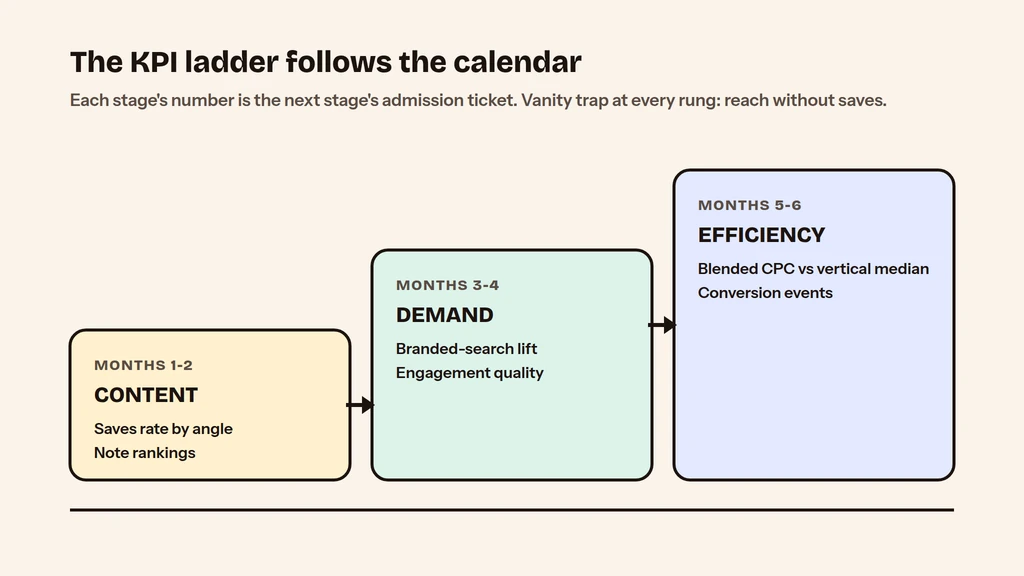
Months 1-2 read saves rate and note rankings: does the content resonate and can it rank. Months 3-4 read branded-search lift and engagement quality: is demand forming around the brand name. Months 5-6 read blended CPC against vertical medians and conversion events: is scale efficient. The vanity trap at every stage is reach without saves, impressions that flatter the report and predict nothing. And the measurement infrastructure is a month-one job, not a month-five discovery: conversion tracking needs technical integration and brand-search monitoring needs a baseline, both before the first creator note publishes.
Prerequisites: what must exist before month one
Six things, and every one has stalled a real launch. They look administrative, which is why they get scheduled "in parallel" and then aren't ready when the calendar needs them: verification reviews take days but document assembly takes weeks, payment routes involve third parties with their own timelines, and whitelist rulings answer on the platform's clock, not yours. Sequence them first.
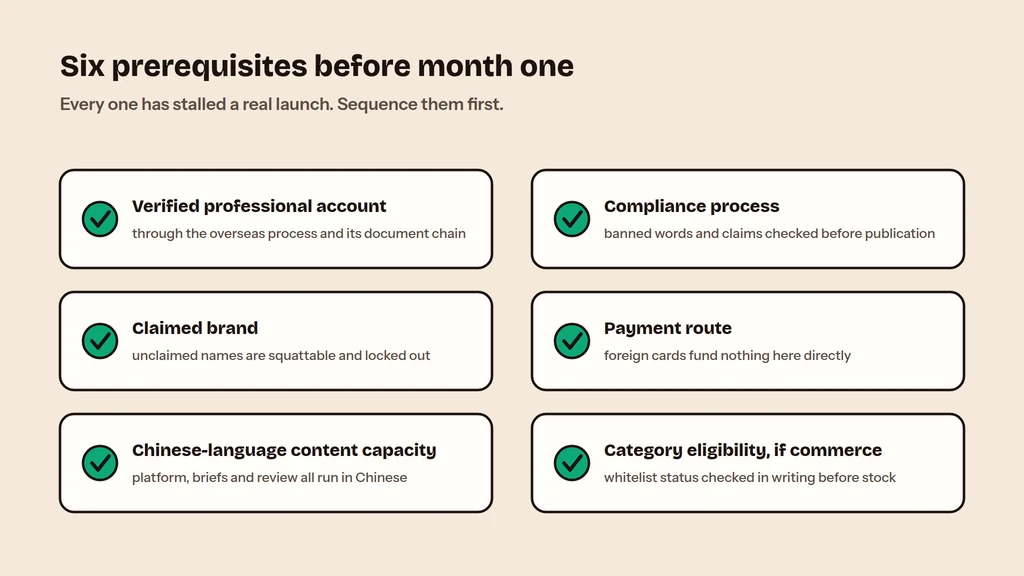
- A verified professional account, through the overseas process with its document chain and hidden requirements.
- A claimed brand, because unclaimed names are squattable and locked out of brand tools.
- Chinese-language content capacity, in-house or through an agency; the platform, briefs and review all run in Chinese.
- A compliance process for banned words and claims, applied to every note and brief before publication, not after rejection.
- A payment route, since foreign cards fund nothing here directly and licensed-processor arrangements take setup time.
- Category eligibility, if commerce is planned: whitelist status and positive-list presence checked in writing before stock decisions (the gates).
The remote-operation question lands here honestly: strategy can run from anywhere, execution can't. Between the language layer, the cultural sensing and the compliance process, the working model for overseas teams is a Chinese-speaking operator somewhere in the loop, whether hired, contracted or agency-side.
The expensive strategic mistakes
Mistake zero is importing an Instagram strategy: same creative, same funnel assumptions, same campaign rhythm. Everything below is a variation on not respecting the platform's actual mechanics.
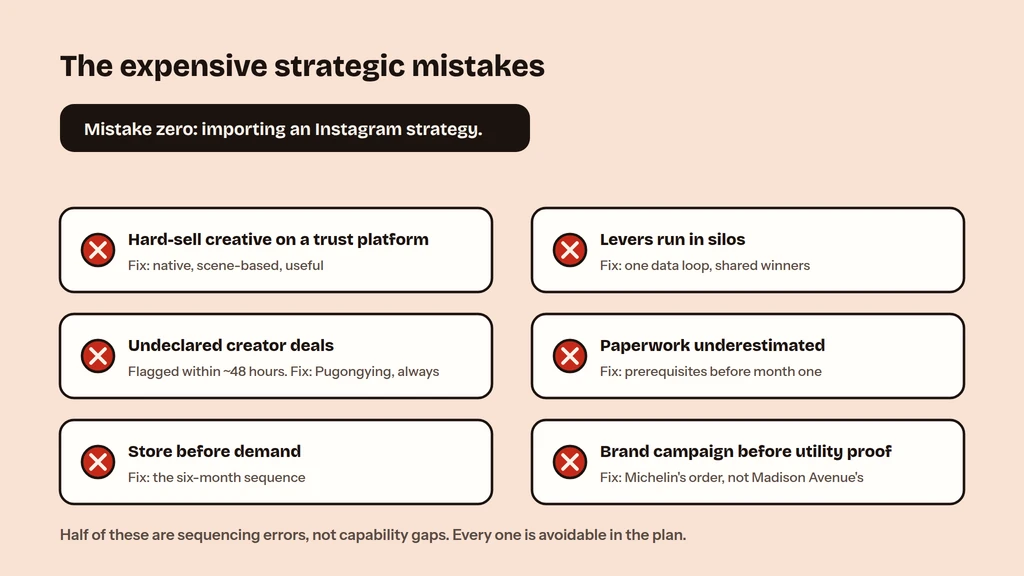
- Hard-sell creative on a trust platform. Polished ad-look content gets suppressed by the algorithm and ignored by users. Fix: native, scene-based, useful.
- Undeclared creator deals. Flagged within about 48 hours, suppressed, and repeat violations cost commercial features. Fix: Pugongying, always.
- Store before demand. Fixed costs waiting for a queue that content hasn't built. Fix: the six-month sequence above.
- Levers run in silos. Creator campaigns and ad campaigns with separate agencies and no shared winners; the amplification loop never closes and the best content expires unused. Fix: one data loop, per the operating model.
- Paperwork underestimated. Payment routing, trademark chains, brand claiming, responsible-person requirements: each is boring until it stalls a quarter. Fix: the prerequisites list, executed before month one.
- Brand campaign before utility proof. Image spend before the platform trusts the brand to be useful. Fix: Michelin's order, not Madison Avenue's.
The encouraging pattern: half of these are sequencing errors, not capability gaps. They kill timelines and budgets, not strategies, and every one is avoidable the cheap way, in the plan.
We can help
This page is the operating system we actually run: sequence, gates, budget bands and the compliance floor. What we add for clients is the execution layer underneath it: Chinese-language content and briefs, vetted creator pools, Juguang operation, and the paperwork chains that stall everyone else. Ask us for a six-month Xiaohongshu plan: fit verdict, stage calendar, budget band for your category, and the KPI baseline set before anything publishes.
FAQ: running the plan
Does a brand need to post every day?
No. A cadence the team can hold beats a daily sprint that dies in week five; three to four strong notes a week through the foundation stage is a working baseline for most brands.
Is a verified account required before creator seeding?
Yes, practically: brand-side Pugongying ordering runs from the verified account, and claiming needs it too. It's the first prerequisite for a reason.
Can Xiaohongshu traffic be sent to our website?
Not from notes; external links don't exist there. Demand closes in-app through store, livestream and DM, or shows up as branded search elsewhere. Plan capture accordingly.
Should we open a store before running ads?
Usually the reverse: ads scale proven content, and product-sales campaigns only make sense once a store (or livestream loop) exists to close. Follow the sequence; commerce is the last gate, not the first.
How often should the six-month plan be reviewed?
At the gates: end of month two, four and six, plus a monthly metrics pass. Re-planning weekly reads noise; waiting six months waives the whole point of the gates.