Xiaohongshu Cross-Border Store: Selling in China Without a Chinese Company (2026)
TLDR
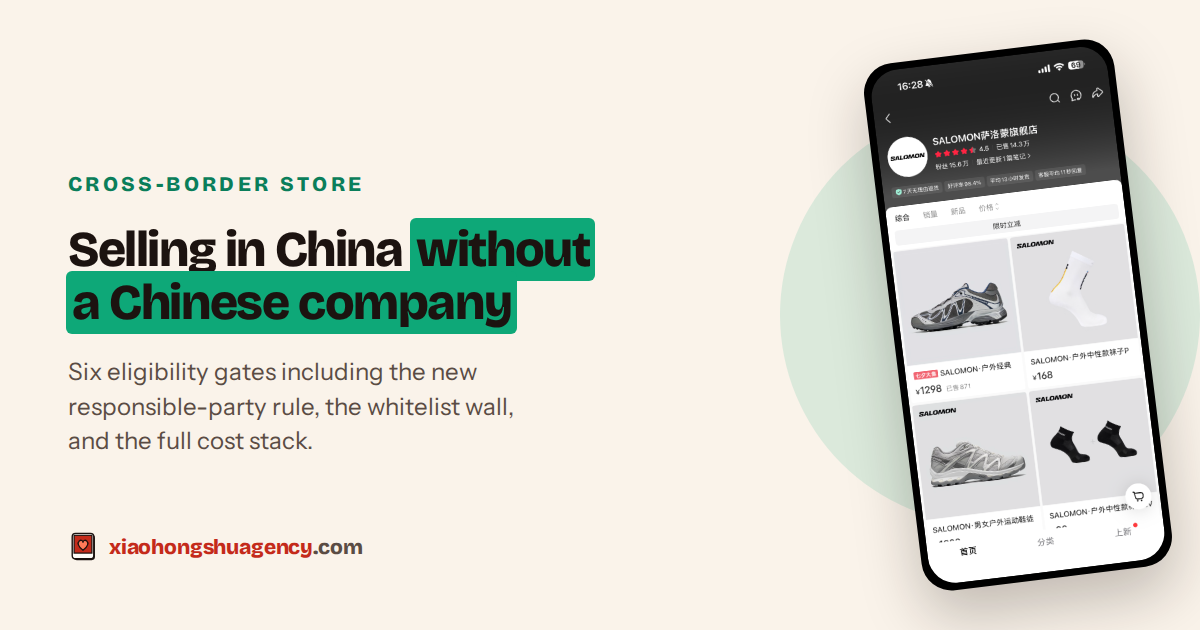
Overseas companies, including Hong Kong, Macau, and Taiwan entities, can sell on Xiaohongshu without a Chinese company through the cross-border store (跨境店). The 2026 catch most English guides miss: imported-goods sellers must designate a domestic responsible party in China to complete filing, an obligation rooted in China's import regulations and now enforced at platform level. The rest of the bill: a verified professional account, a trademark chain, an eligible category (several need whitelisting), a category deposit typically between 5,000 and 50,000 RMB, and settlement through licensed processors to your overseas account. Bonded warehouse and direct-mail logistics both work.
The general "how to open a Xiaohongshu store" walkthrough already exists in plenty of places. This page covers only what changes when you're an overseas company on the cross-border route: the eligibility gates, the whitelist wall, the deposit economics, and how the money gets back out. If a section doesn't differ for cross-border sellers, it isn't here.
Want the store scoped before you commit stock? Our ecommerce team runs feasibility checks.
Can your brand open one? The decision tree
Six gates, in order. Pass all six and the store is available to you; fail one and you know exactly where the work is.
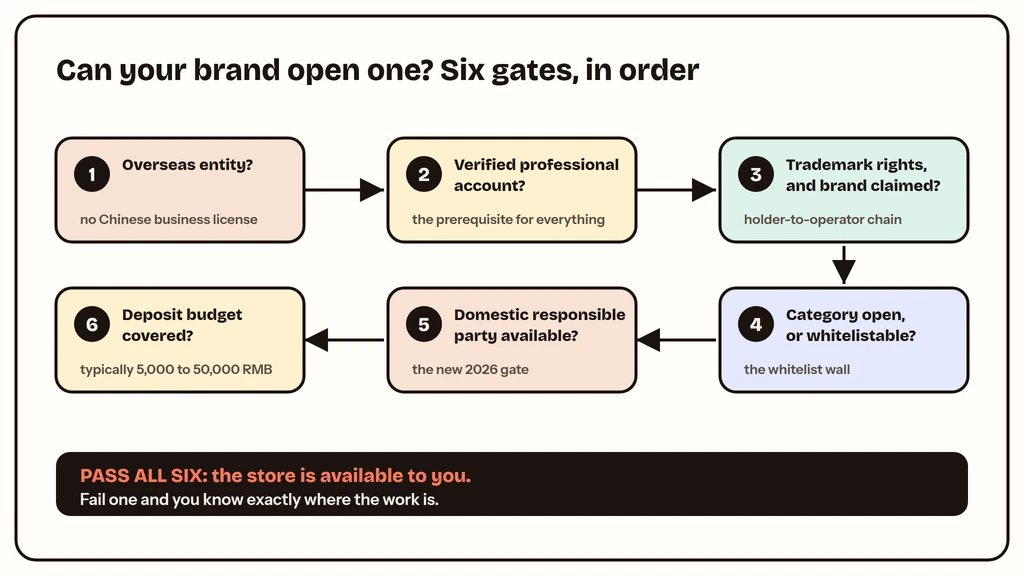
- Overseas entity? The store type exists precisely for companies without a Chinese business license.
- Verified professional account? The prerequisite for everything; our verification guide covers the overseas process.
- Trademark rights, and brand claimed? The store application rides the same holder-to-operator authorization chain, and claiming the brand before applying is the safe default.
- Category open, or whitelistable? The wall described next.
- Domestic responsible party available? The new 2026 gate, detailed in the application section.
- Deposit budget covered? Typically 5,000 to 50,000 RMB by category; the economics section runs the real math.
Category rules: the whitelist wall
Not every category is open to a cross-border application. Beauty, health food, and mother-baby food are among the categories requiring a whitelist approval (报白) before entry; for them, there is no self-serve application to fill in, only an invitation or an approved whitelist request. Two harder gates sit behind the whitelist: the product must appear on China's cross-border retail import positive list at all (goods outside it cannot be sold through this channel, and food and supplements must also satisfy Chinese labeling rules), and special-use cosmetics or beauty devices typically need China filing evidence or overseas GMP certification, approvals that can run months.
This gate confuses Western teams because it inverts the logic they're used to: meeting the criteria doesn't get you in, being on the list does. China has run trade this way before. Under the Canton System, foreign merchants could deal only through licensed hong houses; how rich or reputable the foreigner was made no difference, the license did. 报白 is the same shape at platform scale: an enumerated permission, not a qualifying exam.
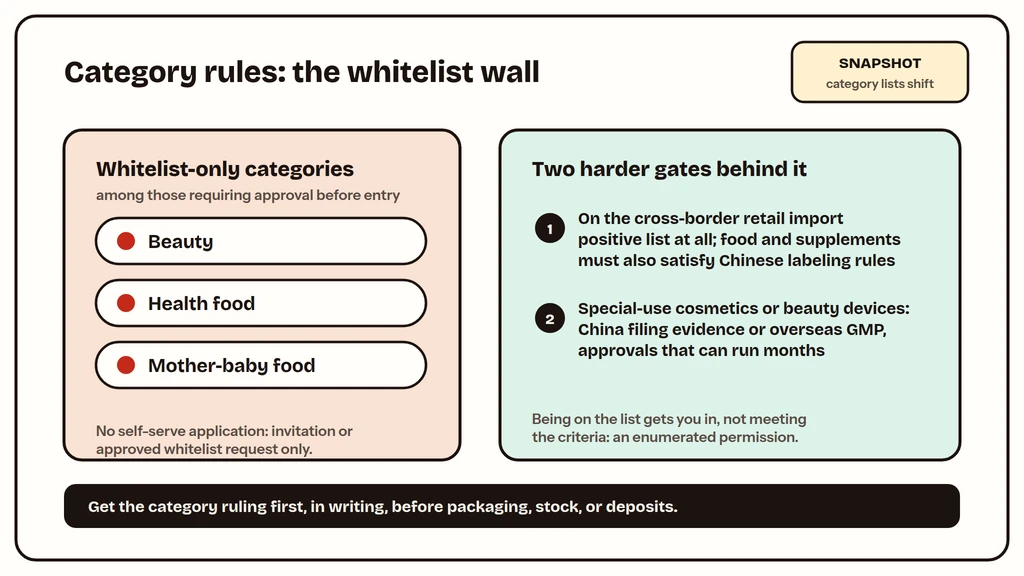
The failure pattern we warn every client about: a brand produces China-labeled stock, then applies, then discovers its category needs a whitelist it doesn't have, and the inventory sits. The fix is procedural and free: get the category ruling first, in writing, before packaging, stock, or deposits. Category lists shift, so treat any published list as a snapshot.
The application, step by step
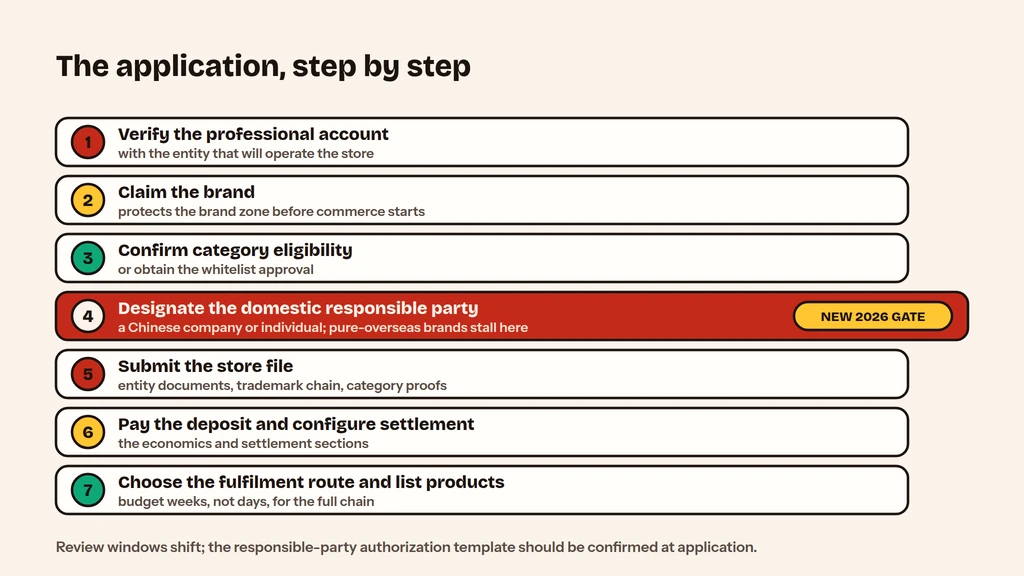
- Verify the professional account with the entity that will operate the store.
- Claim the brand. Same trademark chain, and it protects the brand zone before commerce starts.
- Confirm category eligibility or obtain 报白.
- Designate the domestic responsible party. Under the customs policy issued in April 2026 and the platform's cross-border onboarding rules (updated March 2026), retail imports require a designated domestic responsible person, a Chinese company or individual (a TP partner or affiliated company qualifies) carrying consumer-protection and customs joint liability. It extends obligations China's import regimes already imposed on key categories (CSAR for cosmetics, GACC Decrees 248 and 249 for food). Pure-overseas brands without this party stall at filing. The authorization names the party, its scope of responsibility, and the brand relationship; confirm the current template at application.
- Submit the store file: entity documents, trademark chain, category proofs.
- Pay the deposit and configure settlement (next two sections).
- Choose the fulfilment route and list products. Review windows shift; budget weeks, not days, for the full chain.
The full cost stack
Six separate cost lines. Quotes that show you fewer are hiding something.
| Cost line | Shape | 2026 reference |
|---|---|---|
| Deposit (保证金) | Conditional, by category | Most categories 5,000 to 50,000 RMB; 2026 handbook: ordinary beauty 20,000, special-use cosmetics 50,000, apparel 5,000, supplements 10,000 as ordinary food or 50,000 as health-function food (plus whitelist) |
| Platform commission | % of sales, by category | Base technical service fee ~5%, up to ~10% for some categories; cross-border and livestream fees are separate line items |
| Payment processing | % of settled amount | Processor-dependent, plus FX spread |
| Logistics | Per order | Bonded vs direct mail changes the shape |
| Returns reserve | % of orders | The killer line for cheap goods, see logistics |
| TP or agency fees | Fixed or % where used | Includes the domestic-responsible-party role |
Figure dates. Deposit and commission references: 2026 H1 merchant investment handbook, via practitioner review. These values move by category and season; confirm current figures inside the application flow before budgeting.
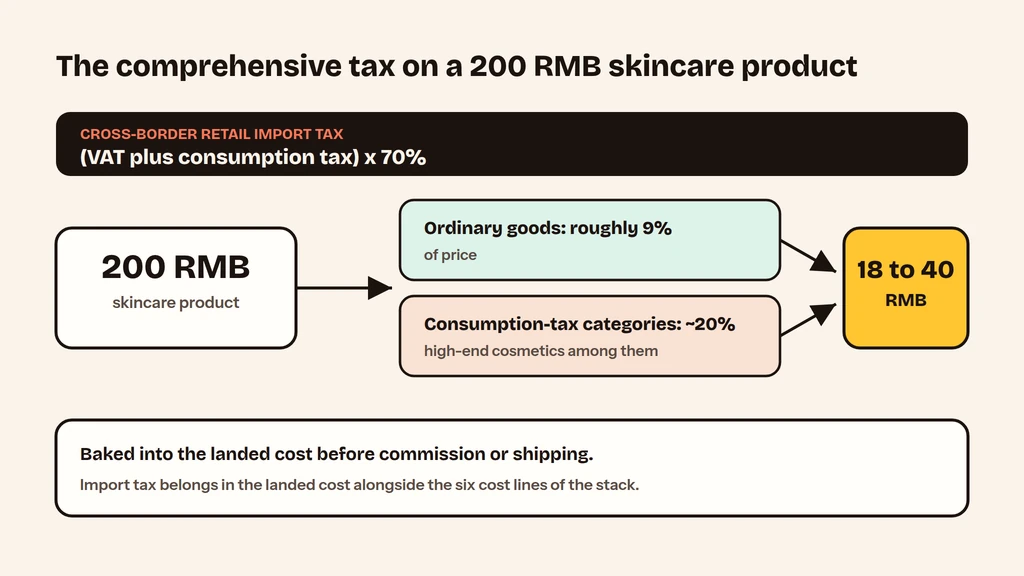
Import tax belongs in the landed cost too. Cross-border retail imports pay the comprehensive tax, calculated as (VAT plus consumption tax) times 70%: roughly 9% of price for ordinary goods, and around 20% for categories that also carry consumption tax, high-end cosmetics among them. On a 200 RMB skincare product, that's about 18 to 40 RMB baked into the landed cost before you've paid commission or shipping.
Now the math that decides whether the store makes sense: the deposit doesn't cost you its face value, it costs you what the locked capital forces. In 2022, airlines flew empty "ghost flights" to keep their Heathrow slots, because a held slot demands activity whether or not the activity pays. A deposit works on the same logic. Take a 50 RMB snack at 12% commission with a 10,000 RMB deposit: you need roughly 83,000 RMB in monthly sales before the deposit's capital lockup stops dominating the P&L. For a thin-margin, low-price catalog, the deposit plus commission can kill the case before the first order, which is exactly what the "wrong answer" section below is for.
Getting paid: settlement
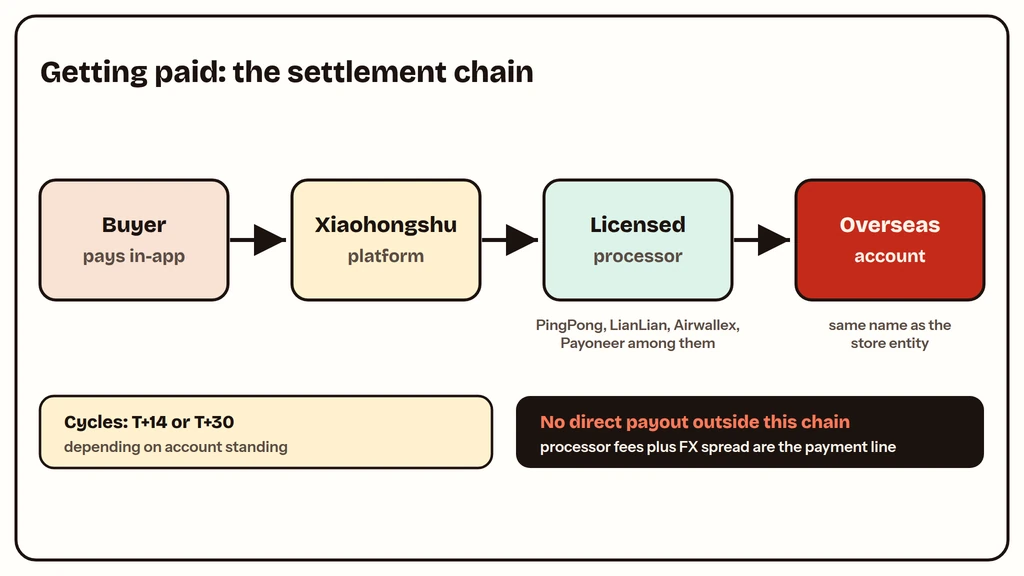
Settlement runs through licensed cross-border processors, PingPong, LianLian, Airwallex, and Payoneer among them, landing in an overseas account under the same name as the store entity. Cycles run T+14 or T+30 depending on account standing. There is no direct payout to a foreign bank outside this chain, and processor fees plus FX spread are the payment-processing line in the table above.
Logistics: bonded vs direct mail, returns included
Both models are supported, and the returns column is where the real decision hides.
| Bonded warehouse | Direct mail | |
|---|---|---|
| Delivery speed | Days, domestic-like | 1 to 3 weeks typical |
| Cost shape | Warehousing + volume commitment | Per-parcel, no stock commitment |
| Stock risk | Real: unsold bonded stock is your problem | Minimal |
| Catalog breadth | Limited to stocked SKUs | Whole catalog |
| Returns | Handled in-country, manageable | Return ships back overseas at freight that can exceed item value, usually with no resale |
Our rule of thumb: bonded for a proven catalog with volume, direct mail for testing breadth. And if your unit price is low with a high-return category, read the returns cell twice; it reappears below.
Store content and traffic reality
Store notes cannot link out to external sites, so the independent-site funnel Western DTC teams default to doesn't exist here. Product notes link the store, and that loop is the machine: notes seed demand, the store closes it inside the app.
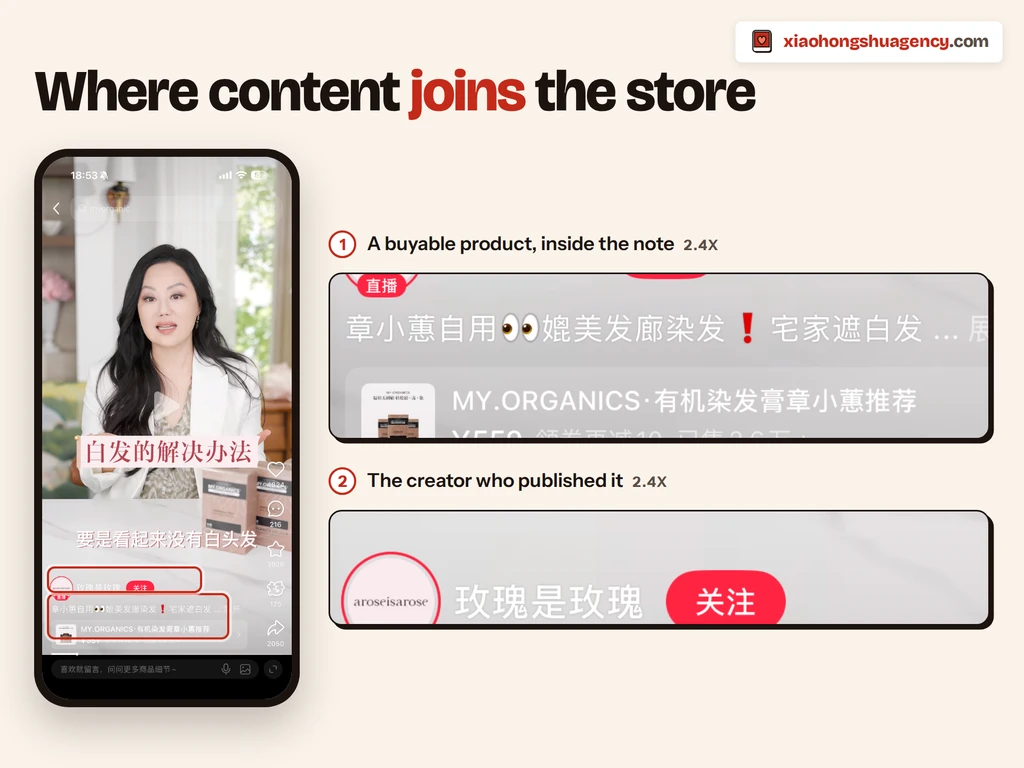
Plan the content engine as part of the store budget, not an afterthought: a store with listings and no note flow is a shelf in a closed room. Livestream commerce has been taking a growing share of cross-border store traffic, worth planning for even if you don't start there. Driving paid traffic into listings is Juguang's job, creator seeding has its own cost math, and the wider selling strategy lives in our selling on Xiaohongshu guide.
When the cross-border store is the wrong answer
Four honest disqualifiers, from feasibility work we've run:
- The margin math fails. If the deposit-occupation calculation above doesn't clear at realistic volumes, the store loses by existing.
- No whitelist path. A gated category with no 报白 route means the store isn't available at any price, whatever your credentials.
- Unit price under roughly 120 to 150 RMB with a high-return category. Direct-mail return freight eats the entire margin; bonded stock risk replaces it.
- You haven't proven demand yet. A content-first phase, seeding notes and creator deals without owned commerce, is often the better first year.
The alternatives, with enough detail to act on: a general domestic store through a Chinese entity is real but not casual, since foreign investment sits behind the negative-list regime and means a WFOE or a local partner, not a quick registration. A TP (trade partner) operation puts an experienced local operator between you and the platform, solving the responsible-party gate and the operations in one contract, in exchange for margin. And the content-first route keeps you building demand while the commerce decision matures. Scoping which of the three fits is most of what our ecommerce agency service does in its first engagement.
We can help
The pattern in this page is that the store fails on gates, not on ambition: the whitelist, the responsible party, the deposit math. We run those checks before anything is committed, with the category ruling in writing, the domestic-responsible-party role covered, and the landed-cost model built for your actual price points. Ask for a cross-border feasibility check: you'll get a yes, a no, or a cheaper path, each with the numbers attached.
FAQ: cross-border store practicalities
Is brand claiming required before applying?
Treat it as yes. The application rides the same trademark chain, and an unclaimed brand is exposed while your commerce application advertises its value. Claim first, apply second.
Can one cross-border store sell multiple brands?
Yes, with the authorization chain in place for every brand sold. Each brand needs its holder-to-operator paper trail; the store type itself distinguishes single-brand and multi-brand formats.
What if our category is invitation-only?
Pursue the whitelist request through the merchant team or an agency with category contacts, or route around it: a TP partner with existing category access, or a content-first phase while the 报白 case builds.
Can we switch from direct mail to bonded fulfilment later?
Yes, it's an operational shift rather than a new store, and starting direct-mail then moving winners into bonded stock is a common sequence. Model the switch before committing warehouse volume.
Who handles customer returns for overseas orders?
The platform-side process manages the customer interaction; the cost lands on the seller. Under direct mail that means international return freight on goods you usually can't resell, which is why the returns line sits in the cost table.