Xiaohongshu KOL Costs in 2026: Real Price Ranges and All-In Budgets
TLDR
As of 2026 H1, a Xiaohongshu KOC or tail creator (1,000 to 50,000 followers) charges roughly 500 to 3,000 RMB for an image-text note, waist creators (50k to 500k) run 3,000 to 30,000 RMB, and head creators (500k+) start around 30,000 RMB, with video at about 1.5x image-text rates. The quote is not the budget: add the flat 10% Pugongying platform fee, amplification, usage rights, and payment costs, and all-in campaign totals land around 1.5 to 2x the sum of creator quotes. Compliant brand deals go through Pugongying (报备); undeclared deals get flagged by the platform's detection systems and throttled.
Every agency publishes a Xiaohongshu KOL price table. Almost none of them tell you what a campaign actually costs once the platform fee, the boost budget, and the payment chain pile on. We negotiate these deals weekly, so this page gives you both: the current ranges, and the arithmetic from a creator's quote to the number your finance team will actually approve. How the deals fit a wider campaign lives in our influencer marketing guide; this page owns the money.
Want the creator mix priced for your brand? Talk to our influencer team.
The price table: what a post costs in 2026
The ranges below aggregate MCN rate cards and third-party pricing data (Chanmama and Qiangua observations, May 2026), cross-checked against Q1 2026 agency pricing surveys. They're the conservative practitioner band; hot verticals push the top end.
| Tier (Chinese market terms) | Followers | Image-text note | Video note |
|---|---|---|---|
| KOC / tail (尾部) | 1k to 50k | 500 to 3,000 RMB | ~1.5x image-text |
| Waist (腰部) | 50k to 500k | 3,000 to 30,000 RMB | ~1.5x image-text |
| Head (头部) | 500k+ | from 30,000 RMB | six figures for top accounts |
Two reading notes. First, the tiers use Chinese-market language on purpose: KOC, tail, waist, head is how every MCN and rate card in the market is organized, and the Western micro/macro labels map onto them only loosely. The KOC tier starts at just 1,000 followers because that's the Pugongying registration threshold under the 2026 entry rules. Second, vertical moves price more than the table shows: at the same 500k followers, a beauty creator quotes 20,000 to 30,000 RMB per note while a travel creator sits around 12,000 to 18,000 (2026 Q1 observations).
One more number worth knowing before you negotiate: listed rates rose roughly 10 to 15% through 2025 while actually-paid prices slipped 3 to 5%, per third-party monitoring (Chanmama and Qiangua-class data plus agency surveys, including Fashion China's Q1 2026 pricing review). The gap between rate card and closed deal sat around 15 points in 2025 and has widened toward 18 to 20 in the first half of 2026. Negotiating inside that spread is normal market behavior, not a special favor.
And be clear about what a quote buys. Gifting product buys consideration, not publication; a creator who accepts your samples has promised nothing. Guaranteed publication is what the paid, declared deal is for.
Why quotes vary 3x for the same follower count
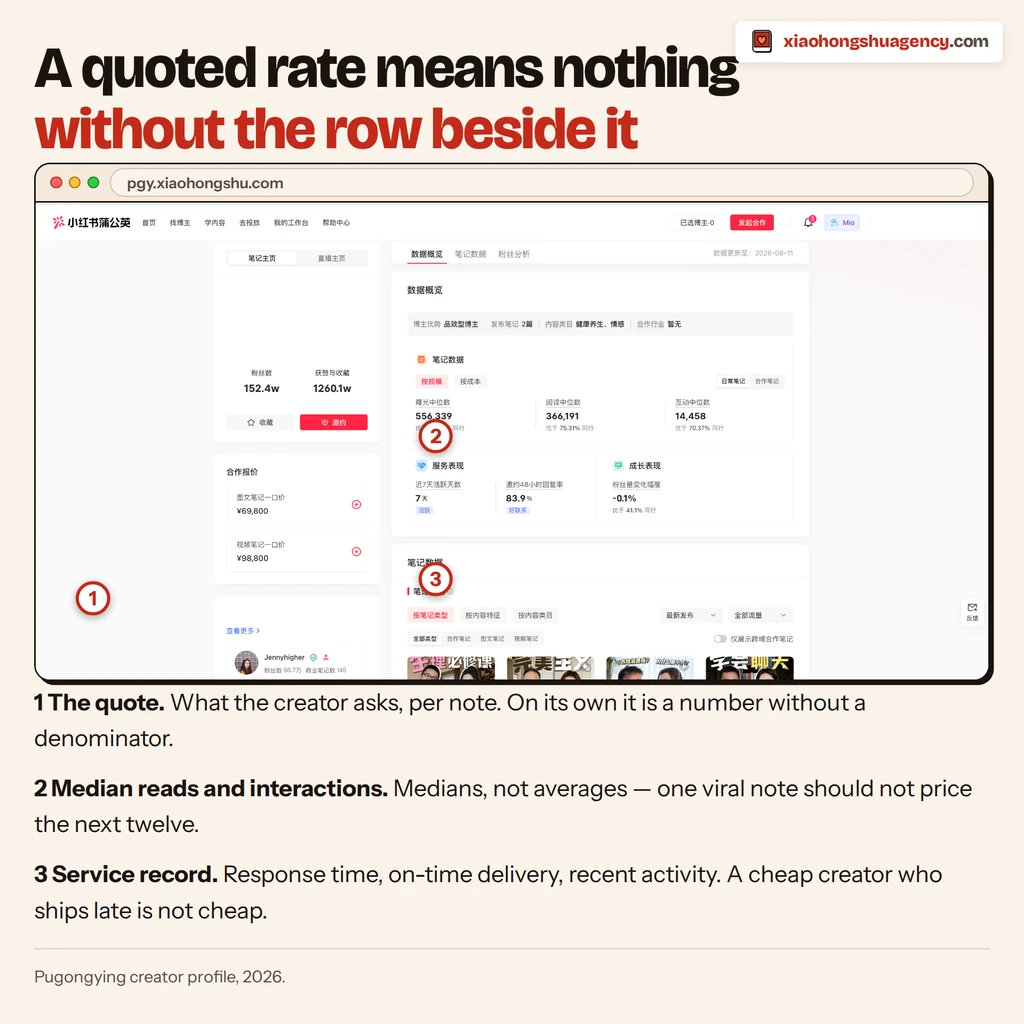
Five drivers explain most of the spread: vertical, content format, usage rights, declaration status, and timing. The sixth driver is the one the table can't show: data quality. Two accounts with identical follower counts can differ several-fold in commercial value depending on engagement quality, save rates, and vertical fit, which is why we vet creators on performance data rather than follower counts.
Wine went through this exact lesson in 1976. At the Judgment of Paris tasting, unknown Napa bottles beat famous Bordeaux labels blind, and the market discovered that price had been following the label, not the liquid. Follower count is the label. Blind performance data is the liquid, and on RED the platform actually lets you taste before you buy.
The other drivers, briefly: usage rights and exclusivity riders quietly inflate quotes, so ask what's included rather than assume. Declared (报备) deals price 10 to 20% higher because the platform fee and the creator's withheld income tax get baked in. Timing bites hardest at the top: head-creator calendars book two to three months out, and peak windows (618, Double 11, CNY) carry rush premiums of 20 to 40%, per Q1 2026 survey data. If you want a Christmas campaign with a head creator, the deal closes in September.
Also new in the pricing structure: Pugongying's buyer mode (买手合作), where creators attach livestream slots or product links and take a separate commission split. It shifts deals from flat fees toward performance splits, and it's worth asking any commerce-focused creator about. Watch the line items too: a 2,000 RMB tail-creator quote sometimes includes a couple hundred RMB of self-run Shutiao boosting. Nothing wrong with the practice, but you want it itemized, not discovered.
From quote to all-in budget: the cost formula
The formula we price every campaign with:
Creator fees + 10% platform fee + usage rights + product and logistics + amplification + payment costs (~3 to 5%) + management = total campaign budget
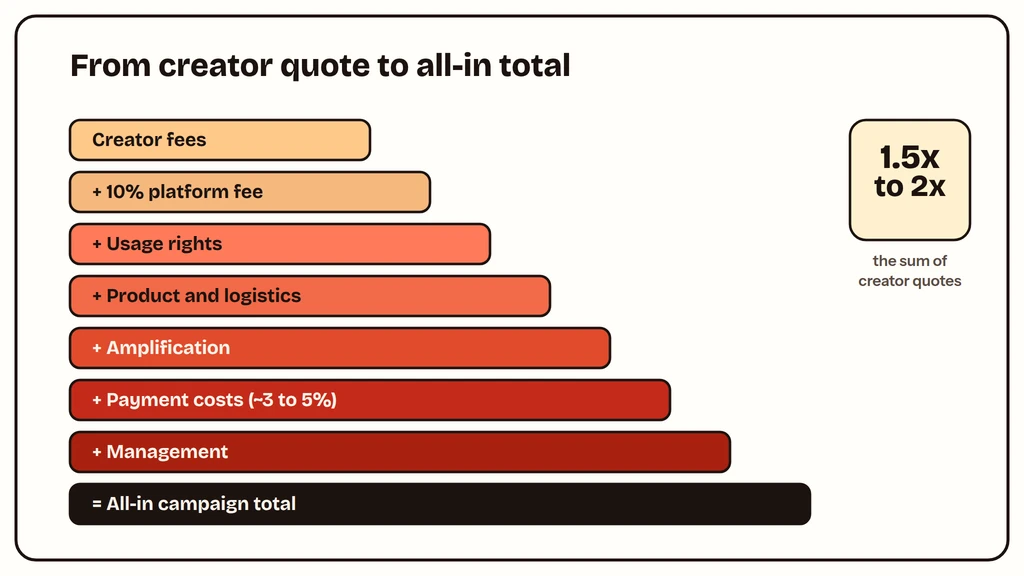
The platform fee is 10% of the transaction (before tax) on declared Pugongying deals, paid brand-side, in force since July 2025 per the platform's official fee notice and unchanged into 2026; boosting declared content carries its own 5% content-heating service fee on top. What the 10% buys is real: the contract, the campaign data reporting, and the compliance cover that keeps the note alive. The platform also withholds the creator's income tax on declared deals, which is precisely why creators quote higher through Pugongying; the sticker difference is mostly the tax and fee surfacing, not extra margin.
Payment costs are the line Western budgets forget. You're budgeting in USD, creators quote in RMB, and the cross-border payment chain takes roughly 3 to 5% in fees and FX spread. On a 200,000 RMB campaign, that's a waist creator's worth of budget quietly gone.
Three worked scenarios
The budget shapes we actually build, with 2026 H1 ranges. Treat the totals as planning bands, not quotes.
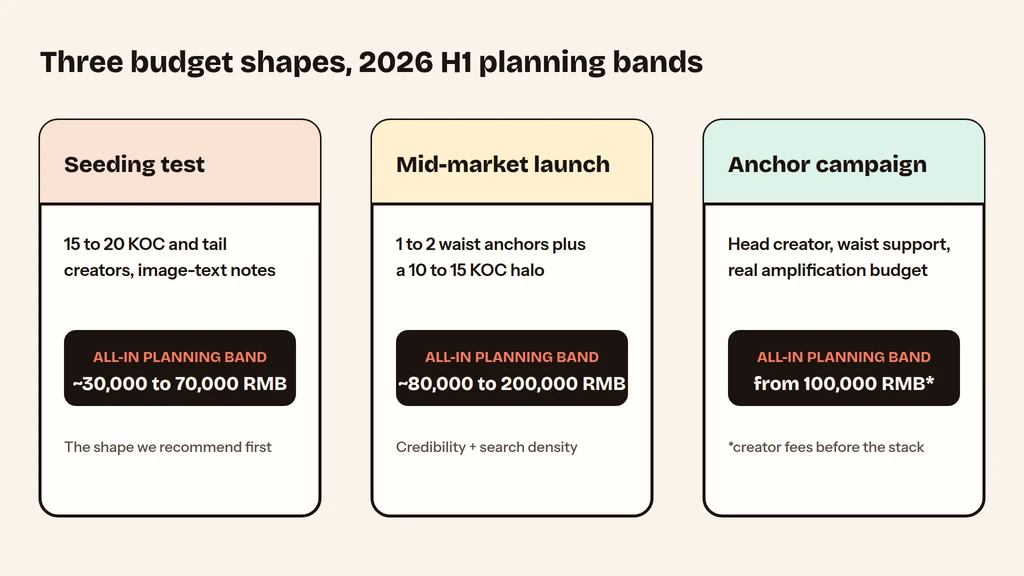
Seeding test. 15 to 20 KOC and tail creators on image-text notes. Creator fees 15,000 to 45,000 RMB, plus the 10% fee, product and shipping for every creator, and a small Shutiao budget to boost the winners. All-in: roughly 30,000 to 70,000 RMB. This is the shape we recommend first for most consumer brands, because it buys market signal, a content bank, and a shortlist of creators worth re-booking.
Mid-market launch. One or two waist anchors plus a 10-to-15 KOC halo, mixed formats. Creator fees 40,000 to 120,000 RMB; all-in roughly 80,000 to 200,000 RMB once fees, product, amplification, and payment costs stack. The waist anchor supplies credibility, the halo supplies search-result density when users go checking whether real people use the product.
Anchor campaign. A head creator plus waist support and a real amplification budget. Creator fees from 100,000 RMB before the stack. Worth it for launches that need one big cultural moment; wasted on brands that haven't proven message-market fit with the cheaper shapes first. When paid reach matters more than the creator's face, Juguang spend often beats head-creator spend for the same money.
Baobei or not: the real cost difference
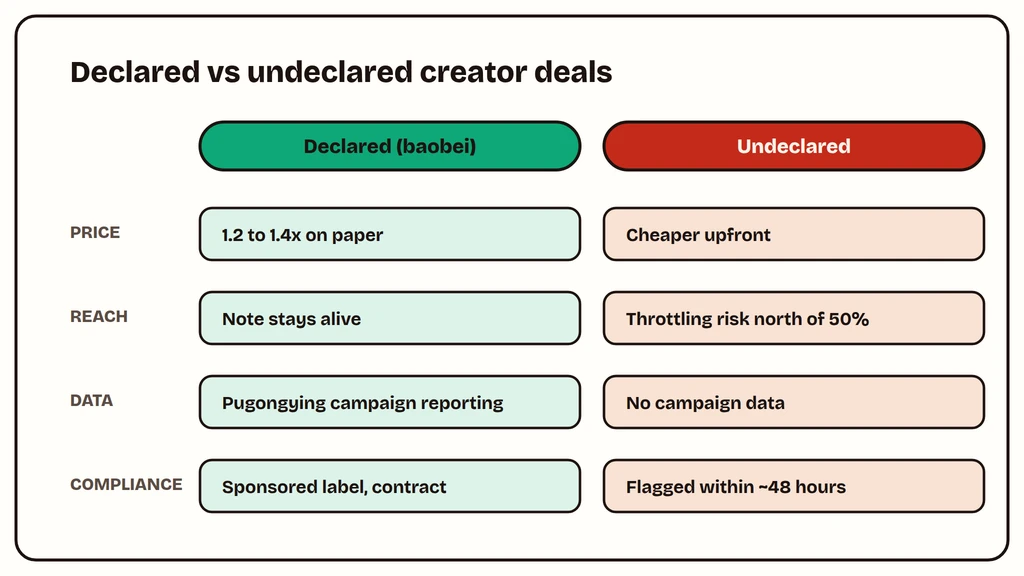
Declared deals cost about 1.2 to 1.4x the undeclared version of the same cooperation on paper. The discount is the trap. Since 2025, the platform's detection systems flag suspected commercial notes typically within about 48 hours of posting; undeclared ones face suppressed reach and lost brand-search placement, and accumulated violations trigger suspension of commercial features and account demotion rather than outright bans (2025 community convention, MCN field tests). Practitioner shorthand: undeclared notes face a throttling risk north of 50%.
Gray-market watches run on the same economics: 20% off the boutique price, warranty void, and one service bill erases years of the saving. Same product, no protection. That's the undeclared deal exactly, with one addition: your creator's Western-style superlatives ("best serum in the world") are banned-word violations that can take the note down on their own, so unapproved copy can burn the fee even before detection does.
Our position, plainly: for foreign brands the undeclared discount is rarely worth it. The brand-safety downside is asymmetric, and you're the party least equipped to see the throttling happen.
We can help
If the fee stack and the scenario math above look like more procurement than marketing, that's an accurate picture of how creator campaigns on RED actually run. Our team negotiates Pugongying deals, itemizes the quotes, and builds the KOC-to-head mix against your budget rather than a rate card. Get a costed creator plan: tiers, counts, all-in total, and what we'd cut if the budget shrinks 30%.
FAQ: Xiaohongshu KOL pricing
Does a Xiaohongshu KOL quote normally include Shutiao promotion?
Sometimes, especially at the tail tier, and it's often unlabeled. Ask for the line-item split so you know how much buys the creator's work and how much buys paid reach.
How many KOCs should a first campaign use?
15 to 20 is our standard seeding test. Fewer than 10 rarely produces enough data to tell signal from luck; more than 25 wastes budget before you know which content angle lands.
Are usage rights included in the post price?
Assume no. Base quotes typically cover the note on the creator's account. Repurposing the content in your ads, store, or other channels is a rider, and it's cheaper negotiated upfront than after the note performs.
Is product gifting enough to get published?
No. Gifting buys consideration; creators who accept samples have promised nothing. Guaranteed publication with agreed content comes from a paid, declared deal.
Should we negotiate per post or as a campaign package?
Package, with staged deliverables. Multi-note packages discount 20 to 30% against listed rates (Q1 2026 survey data), and staging lets you drop underperforming creators between waves.