Xiaohongshu Advertising: How Paid Promotion Works on RED (2026)
TLDR
Foreign brands can advertise on Xiaohongshu with three things in place: a verified professional account, a complete trademark authorization chain, and a payment route through a licensed cross-border processor. The route decision comes down to this: Juguang feed ads for scale, Juguang search ads for capturing purchase intent, Shutiao for testing organic winners, and Pugongying for creator content. A meaningful test starts at 5,000 to 10,000 RMB (about $700 to $1,400) as of mid-2026, far below the cold-start budgets Tmall or Douyin demand.
Most overseas marketers arrive at Xiaohongshu advertising from a Meta or Google frame, and that frame breaks quickly here. The platform Chinese users call RED runs its paid system on different rails: a Chinese-only ads manager, an account structure gated behind document chains, and an audience that actively punishes anything that looks like an ad. This page maps the whole paid system so you can decide what to run, what it costs, and what to prepare before spending a yuan. We run these campaigns daily for overseas consumer brands, so expect the version with the traps included.
Already evaluating agencies? See how we manage RED ad accounts for overseas brands.
Can your brand advertise on Xiaohongshu?
Yes, for most consumer categories, and without a Chinese business license. What you need instead is a verified professional account (专业号), a trademark chain that connects the rights holder to the advertiser, and a way to fund the account, since foreign cards don't work. Each prerequisite gets its own section further down.
The invisible killers. Some industries hit a wall regardless of paperwork. Supplements, finance, crypto, and parts of medical aesthetics face rejection at review, extra credential demands, or category exclusions outright. Health and cosmeceutical brands have faced tighter checks since 2025, including requests for NMPA filing evidence even when production sits outside China. If you're in one of these categories, get a category ruling before you plan anything else.
Choose the right promotion route
Xiaohongshu paid promotion splits into four routes, and picking the wrong one is the most common way foreign brands burn a first budget. Here's the comparison we walk clients through:
| Route | Best for | Conversion components | Entry cost shape | Pick it when |
|---|---|---|---|---|
| Juguang feed ads | Scaled reach, product sales | Yes: product cards, forms, store links | Auction CPC/CPM | You have proven content and want volume |
| Juguang search ads | Capturing active purchase intent | Yes | Keyword CPC auction | Your category gets searched (it does) |
| Shutiao boost | Testing which notes deserve budget | No. Reach only | CPM, about 8 to 12 RMB per 1,000 impressions (2026 Q1 agency tests) | You want cheap signal before committing |
| Pugongying creator deals | Trust-building seeded content | Via creator notes | Fee per creator plus 10% platform fee | Covered in our influencer marketing guide |
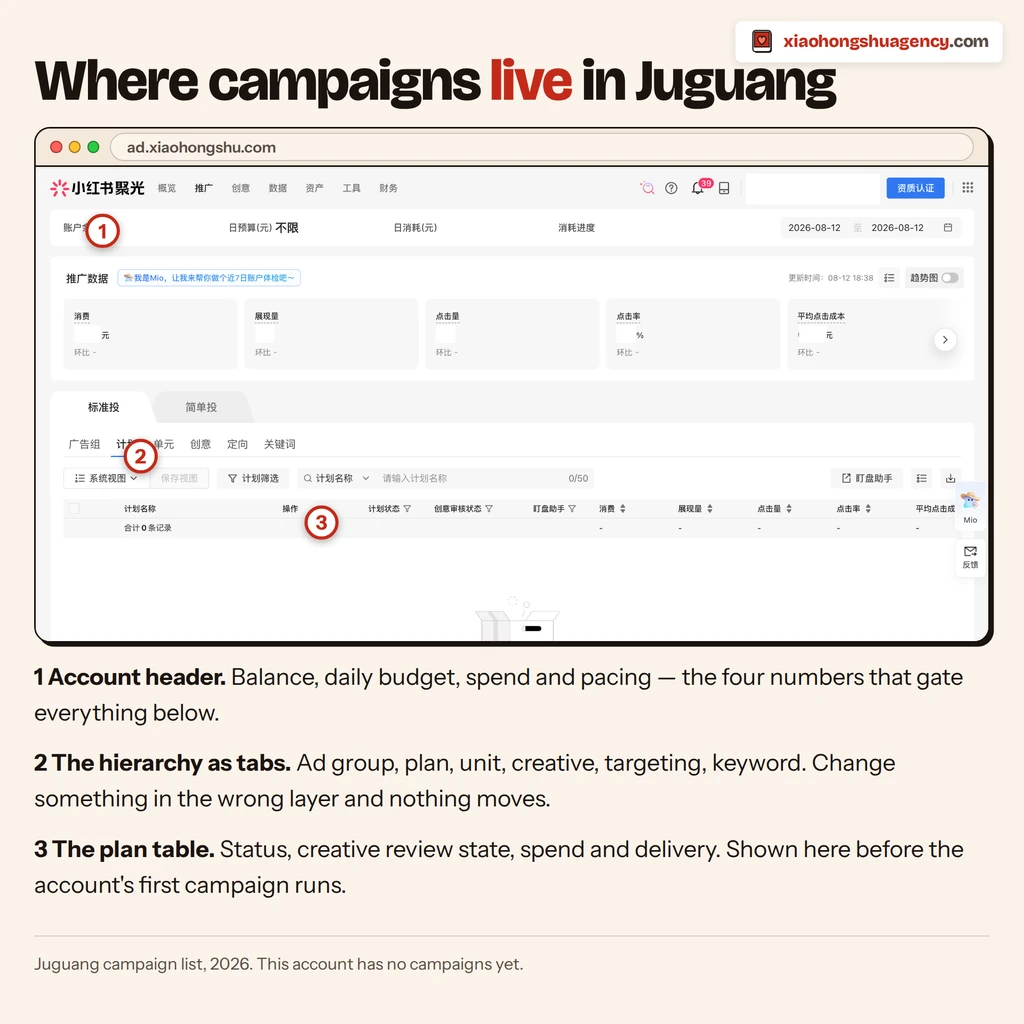
All the ad buying happens inside Juguang (聚光), the platform's unified ads manager covering feed, search, and video placements. It merged from earlier separate tools and runs in Chinese only. A lighter version, Juguang Lite, launched in Q3 2025 for smaller advertisers; it lowers the entry bar but cuts features you'll eventually want, search-term reports being the painful one. Fine for a toe in the water, not for running the account long term.
Shutiao is not an ads product. The boost tool (薯条) heats organic notes for visibility and cannot carry product links, forms, or any conversion component. When a vendor quotes you "Xiaohongshu ads" run through Shutiao, you're buying reach, not performance. We've reviewed more than one media plan where this distinction was quietly missing.
Objectives, targeting and placements
Juguang offers five campaign objectives as of mid-2026: brand exposure, click and engagement, product sales, direct-message lead generation, and livestream traffic. Map them the way you'd expect: exposure for awareness, clicks for consideration, product sales and DM leads for conversion, livestream for commerce events.
The feed-versus-search decision matters more than the objective picker. Feed ads buy discovery among users who weren't looking; search ads buy the moment they are. When a user types 祛痘精华 (acne serum) into RED's search bar, a brand note bidding on that keyword can sit at the top of results, at roughly 0.5 to 2.0 RMB per click on 2026 Q1 account data. Purchase intent that explicit is rare inventory on any Chinese platform, and it's the reason we usually tell search-heavy categories to start there rather than in the feed.
Targeting covers interest tags, demographics, keywords, devices, and lookalike-style expansion. The operator-level detail, including which interest tags exist and how the campaign hierarchy works, lives in our Juguang walkthrough.
What Xiaohongshu ads cost
Enough numbers to budget with, all dated, since these move: the platform's first-recharge floor sits around 5,000 RMB, with some resellers going lower and agency cross-border packages typically setting 10,000 to 20,000 RMB as the first top-up. Treat the exact figure as "per current policy and your agency agreement."
On delivery costs, 2026 first-half tested ranges look like this: feed CPC commonly 0.8 to 3 RMB (medians sit around 0.9 to 1.5), lifestyle CPM around 40 to 80 RMB, search CPC around 1 to 3 RMB with beauty pushing 4 to 6. The ranges vary widely by vertical and creative quality. A meaningful first test runs 5,000 to 10,000 RMB, which is the part that surprises marketers coming from Tmall or Douyin, where cold starts routinely need several times that.
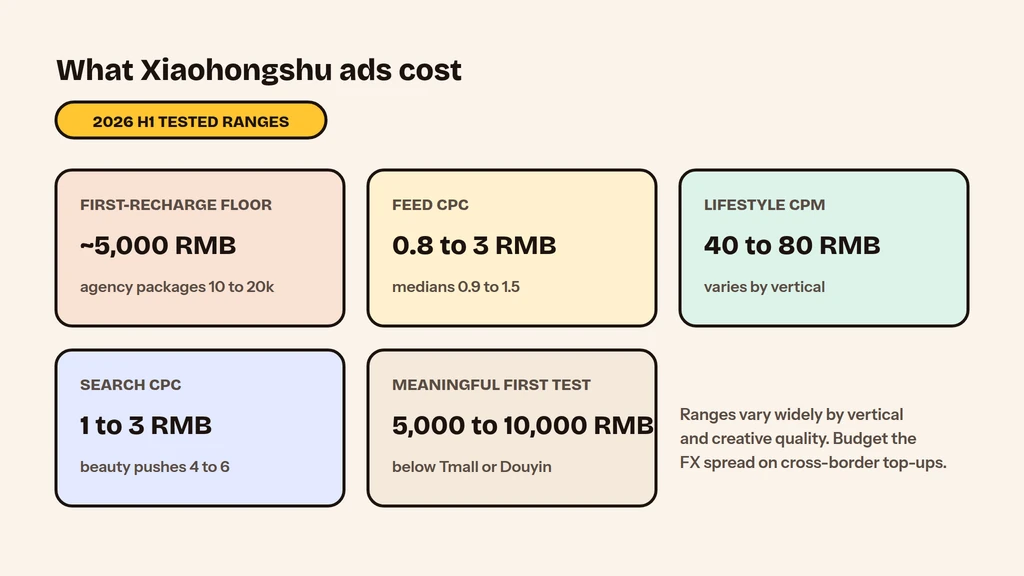
One cost nobody puts on the rate card: currency friction. You'll typically recharge in USD through a licensed processor while spending in RMB, and the FX spread plus a slow refund path for unspent balances is real money on small budgets. Budget the spread, and don't park more in the account than you plan to spend that quarter.
The full breakdown by format and vertical sits in our Xiaohongshu ads cost guide. And if you'd rather hand the whole machine to a team that already runs it, that's exactly what our RED ads management service is for.
What foreign brands must prepare
Three chains, in this order: account, trademark, payment. Get them wrong and the account opening stalls for weeks; get them right and approval is a 1 to 3 working day formality.
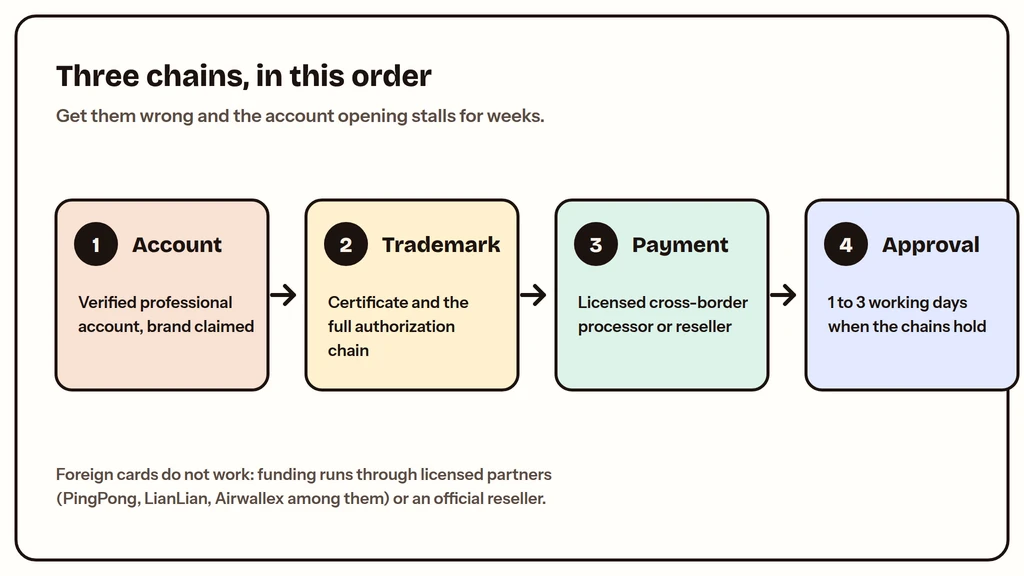
The account. Everything commercial on RED starts with a verified professional account. The verification process for overseas entities, including the document list and the hidden prerequisites, is covered step by step in our account verification guide.
The trademark chain. Ad account opening requires the trademark registration certificate (or acceptance notice) plus a complete authorization chain from the trademark holder down to the advertiser. This is where "we have a distributor in China" fails: a distribution agreement is not a trademark authorization, and review teams reject the file if any link in the chain is missing. Per the 2025 Juguang account-opening requirements, the chain must be complete at every level.
The payment route. Juguang does not accept foreign credit or debit cards. Funding runs through the platform's licensed cross-border payment partners, PingPong, LianLian, and Airwallex among them, or through an official reseller who tops up on your behalf. One accounting wrinkle to flag to your finance team early: the fapiao (Chinese invoice) issues to the verified China-side entity, never to your overseas HQ, so reimbursement paperwork needs a plan.
Creative and review constraints
RED users punish ad-looking ads, and the platform's review system enforces taste before the audience even gets the chance. Money alone does not buy delivery here. The auction is real, but a hard-sell creative with a polished-campaign look will clear review and then die on click-through, because the entire platform culture is built on 种草 (zhongcao, "seeding"): peer recommendations that read like a friend's note, not a billboard.
Walmart learned the shape of this lesson in South Korea. It arrived with a proven big-box formula, ran it exactly as written, and sold its stores to a local rival in 2006, because Korean shoppers bought fresh food daily in small trips and the formula never adapted. Importing a winning formula into a market that runs on different rules is precisely what a Meta-optimized ad does on RED. The formula isn't wrong. It's wrong here.
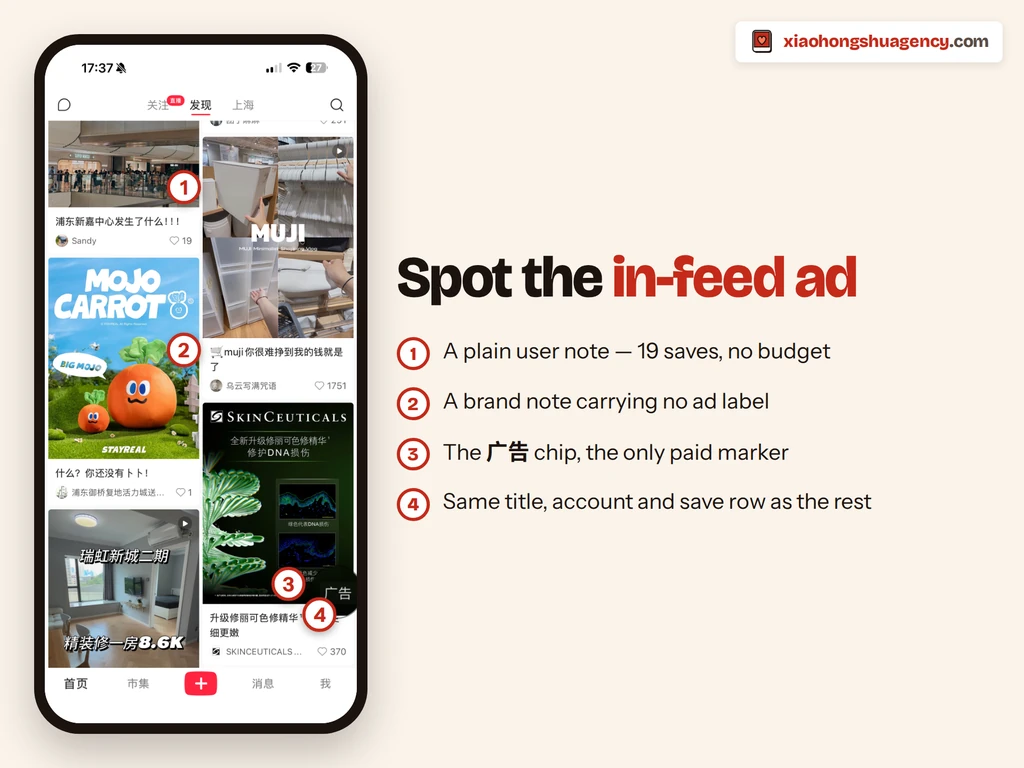
Review adds a second, sharper constraint. Absolute claims are banned words: nothing phrased as 最 ("the most"), "No. 1," or their cousins survives. Health-adjacent products cannot imply therapeutic effect; sensory language passes where curative language dies. Creative review usually clears within hours and campaign review takes about one working day (2026 Q2 agency observations), but standards shift, so treat every rule as "as of your submission date." Paid creator content carries its own declaration requirement (报备), which we cover on the influencer side.
The launch workflow
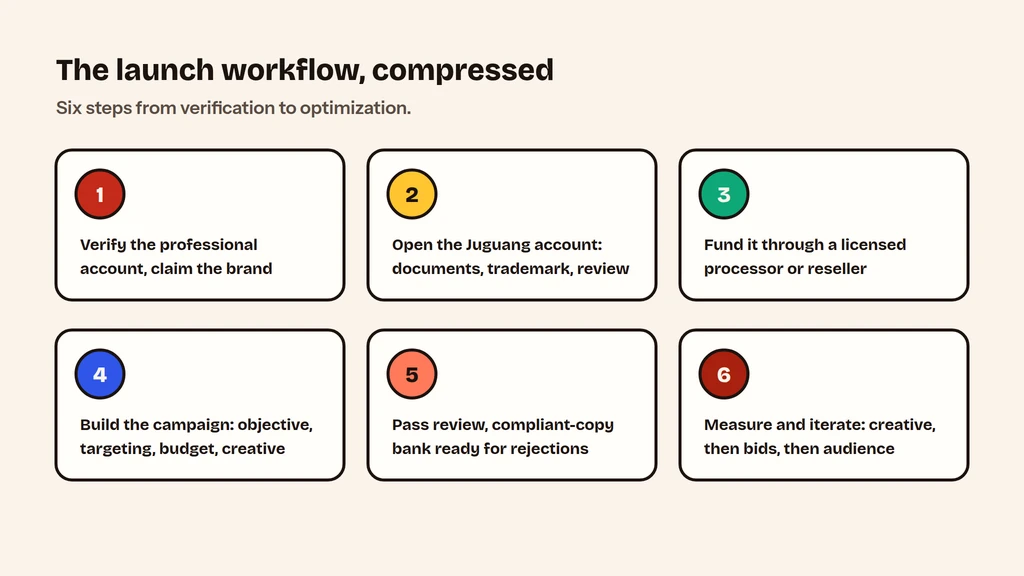
The whole sequence, compressed. We'll go deeper on steps 3 through 6 in the ads manager walkthrough.
- Verify the professional account and claim the brand.
- Open the Juguang account: documents, trademark chain, review.
- Fund it through a licensed processor or reseller.
- Build the campaign: objective, targeting, budget, native-style creative.
- Pass review, with a compliant-copy bank ready for rejections.
- Measure and iterate: creative first, bids second, audience third.
If the goal is store traffic rather than lead generation, read this alongside our guide to selling on Xiaohongshu, since the store and ad accounts interlock.
We can help
If you've read this far, you've probably spotted the pattern: the mechanics are learnable, but the prerequisites (trademark chains, payment routing, compliant creative) are where foreign brands lose their first quarter. That's the part we do every week. Our team runs Juguang accounts and creator campaigns for overseas consumer brands, in Chinese, inside the review rules, with the payment chain already built. Get a RED ads plan for your brand: we'll tell you which route fits, what it will cost, and whether your category clears the invisible killers before you commit a budget.
FAQ: Xiaohongshu advertising
Can a foreign company pay Xiaohongshu directly?
No. Juguang doesn't take foreign cards or direct overseas bank transfers. Funding routes through licensed cross-border processors like PingPong, LianLian, or Airwallex, or through an official reseller who recharges the account for you.
Can an overseas trademark holder authorize a Chinese distributor to advertise?
Yes, and that's the correct structure: a written authorization chain from the trademark holder to the advertising entity. What fails is skipping the chain and submitting a distribution agreement alone. Review checks the trademark line, not the commercial relationship.
Is Shutiao a substitute for Juguang conversion ads?
No. Shutiao boosts the reach of organic notes and cannot carry product links or conversion components. Use it to test which notes earn a real budget, then move the winners into Juguang.
Can we run Xiaohongshu ads without a Chinese-speaking team?
Technically yes, practically no. The interface, the review feedback, and the banned-word rules are all Chinese-only, and one misread rejection can stall a live campaign. Brands without Chinese-reading ops staff almost always run through an agency or reseller.
What is Juguang?
Juguang (聚光) is Xiaohongshu's unified advertising platform, covering feed, search, and video placements with five campaign objectives as of mid-2026. It replaced the platform's earlier separate ad tools and has no official English version.