Xiaohongshu Influencer Marketing: Strategy, Campaign Models and Compliance (2026)
TLDR
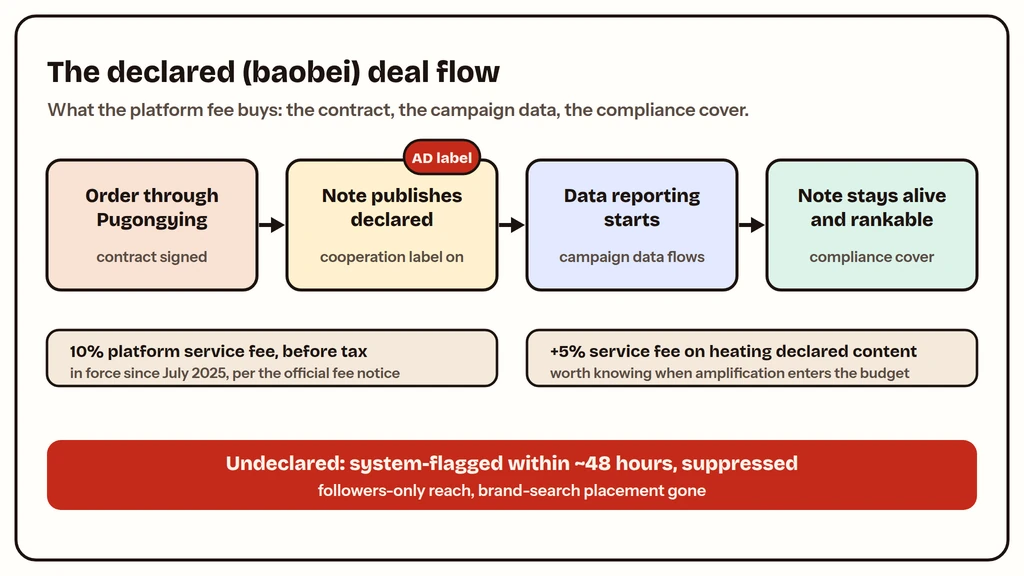
Xiaohongshu influencer marketing is declared creator cooperation through Pugongying (蒲公英), built on zhongcao seeding: many authentic-reading notes intercepting purchase research in feed and search. For most consumer brands, KOC-heavy mixes outperform celebrity buys in low-consideration categories, while high-ticket products need a head-creator anchor for trust. On the money: creator fee plus a 10% platform service fee (before tax), with full economics on our KOL cost page. The compliance floor is absolute: declared deals only, because undeclared commercial notes get flagged within about 48 hours and suppressed.
Creator marketing on RED rewards the brands that treat it as a system and punishes the ones that treat it as a media buy. The system has rules Western influencer marketing doesn't: a mandatory booking platform, an AI referee watching for undeclared deals, and an audience that files good notes away for later instead of double-tapping and forgetting. The strategy layer lives on this page: how demand forms, which campaign model fits which objective, how a compliant campaign actually runs, and what to measure. We run these campaigns weekly for overseas consumer brands; the traps below are the ones we get hired to undo.
Want the campaign built and negotiated for you? Talk to our influencer team.
How influencer marketing produces demand on RED
Creator notes intercept purchase research twice: once in the feed, where discovery happens, and again in search, where users go to verify what they half-remember seeing. That second surface is the one Western marketers underrate. A note that ranks for a category search keeps selling for months after the campaign ends, which changes what you're buying: not a flash of reach, but a small durable asset.
The music business went through this exact revaluation. Old songs stream in small amounts forever, and once the market understood that, catalogs of them started selling for hundreds of millions; Dylan and Springsteen didn't sell hits, they sold compounding assets. A seeded KOC wave works the same way: each note earns modestly, and the catalog is the point. This is why volume seeding builds long-tail acquisition that a single celebrity post never will.
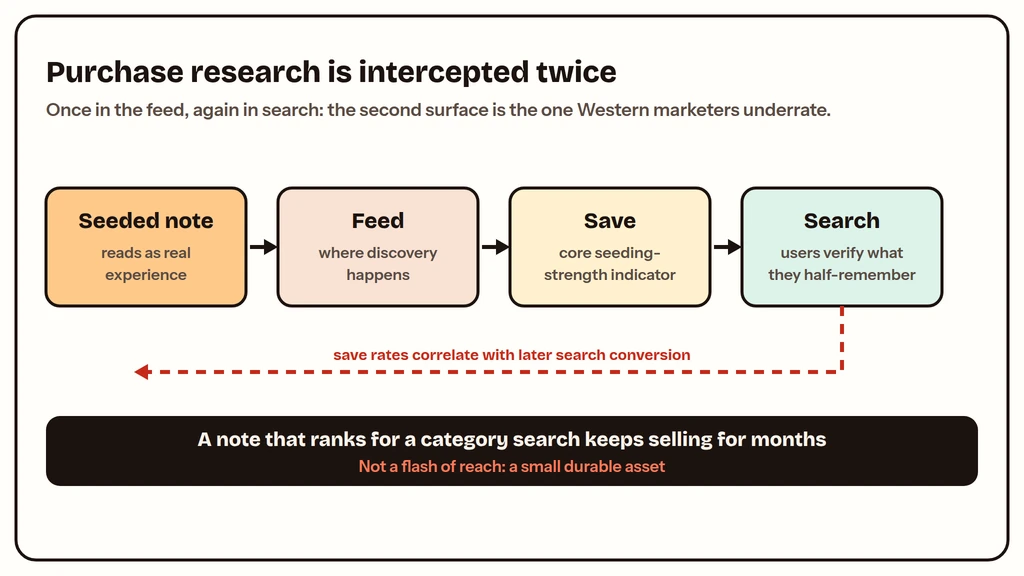
One misconception to kill early: zhongcao (种草, "seeding") is not product placement. A seeded note works because it reads as real experience with information value: what the product did, for whom, with what caveat. Drop a product into a lifestyle shot the Western way and the system reads it as a hard ad and suppresses it, and users who do see it scroll past. Saves are the metric that separates the two: the save rate is the core seeding-strength indicator, and it correlates strongly with later search conversion.
Choosing campaign objectives and formats
Pick the objective first; the format follows. Four objectives cover most briefs: awareness in a new category, branded-search lift, product launch, and store conversion.
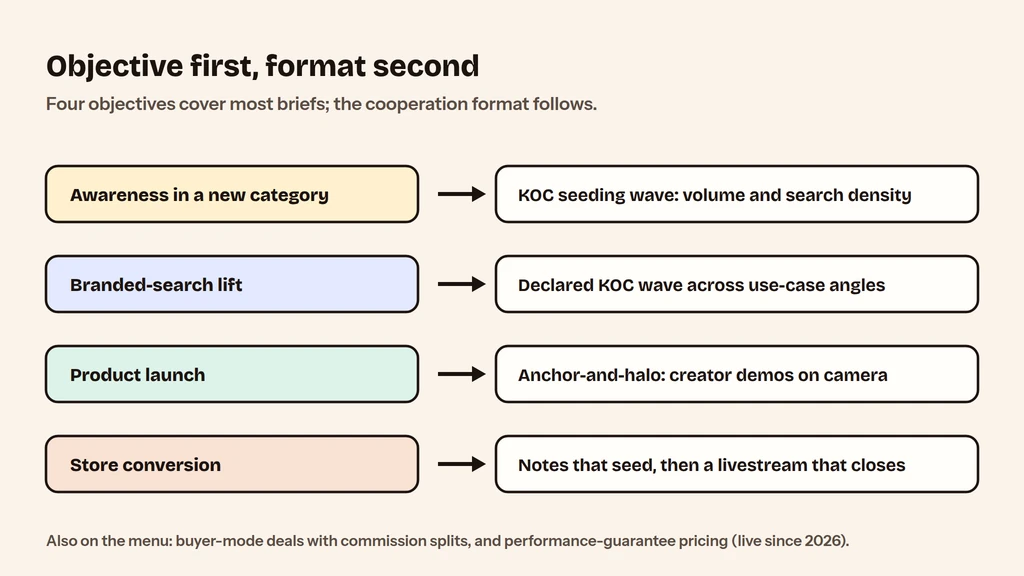
The format menu is wider than it was two years ago. Declared note cooperations remain the base unit. Buyer-mode deals (买手合作) let creators carry livestream slots and product links with a separate commission split, pulling deals toward performance economics. Livestream itself has become the closing mechanism the platform pushes hardest: the current winning loop is notes that seed, then a livestream that closes, and brands expecting note virality alone to move inventory are working against the platform's own current. For budget-sensitive teams, Pugongying's performance-guarantee mode (live since 2026) prices deals against tested engagement costs rather than flat fees, which is worth asking about before committing a fixed budget.
Category bends everything: beauty seeding runs on volume and search density, luxury runs on fewer, more produced notes, and anything high-consideration needs proof content more than lifestyle content. There is no single "Xiaohongshu influencer campaign" shape.
A worked mini-example makes the objective logic concrete. A mid-priced skincare brand entering China wants branded-search lift. The format answer: a declared KOC wave seeded across the brand's three strongest use-case angles, no livestream yet, no store push, with success read on search volume for the brand name plus the hero ingredient. Same brand, six months later, launching a device at ten times the price point: now the format answer flips to anchor-and-halo with a waist creator demonstrating the device on camera, because the objective moved from awareness to trust. Objective first, format second, every time.
Building the KOL/KOC mix
The mix follows decision weight. Low-consideration categories (skincare staples, food and drink, apparel basics) win with KOC volume: many small creators whose notes read as peer word-of-mouth. High-ticket durables (beauty devices, premium appliances) still need a head-creator anchor, because a 2,000-follower account recommending a 3,000 RMB device doesn't carry the trust weight the price demands.
Terminology worth getting right, because rate cards use it: the Pugongying floor is 1,000 followers on a professional account (some verticals like fashion and beauty run invitations down to 500), and "KOC" is a market label for roughly the 1k-50k band, not a gated tier. Above them sit waist creators (50k-500k) and head creators (500k+). Full price ranges by tier live in our KOL cost breakdown; the planning shorthand is that trust-per-RMB is highest at the bottom of the ladder.
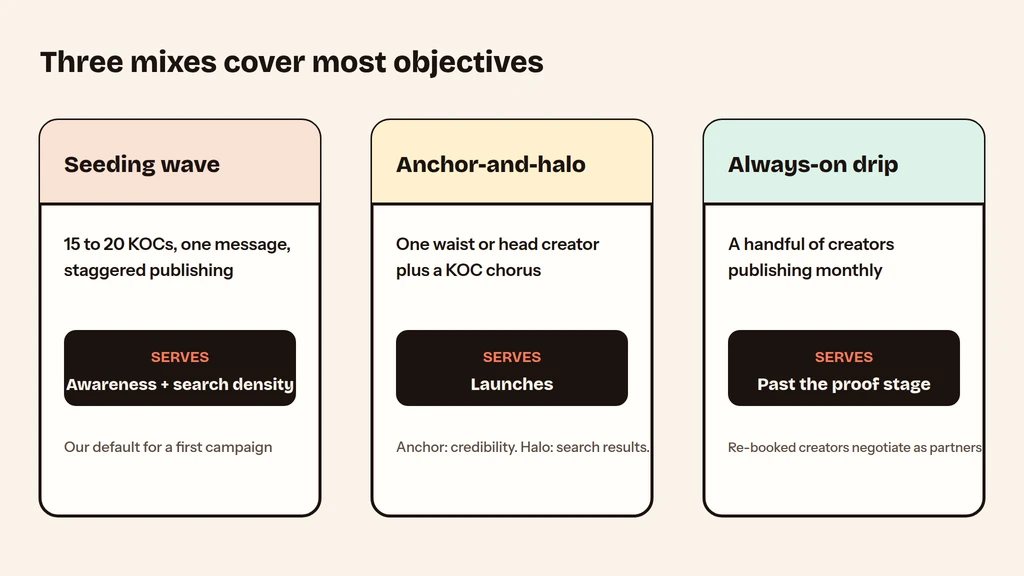
Three mixes cover most objectives. The seeding wave (15-20 KOCs, one message, staggered publishing) serves awareness and search density. Anchor-and-halo (one waist or head creator plus a KOC chorus) serves launches: the anchor supplies credibility, the halo supplies the search results users check afterward. The always-on drip (a handful of creators publishing monthly) serves brands past the proof stage. Our default for a first campaign is the wave: 20 small notes generate data and a content bank that one big post can't, and for most categories that beats the one-KOL bet.
One negotiation fact for the planning stage: listed rates run 10 to 15% above closed prices, and the spread has widened toward 18 to 20 points into 2026 (third-party monitoring via Chanmama and Qiangua-class data plus agency surveys). Budget against closed prices, not rate cards.
How a compliant campaign runs: brief to reporting
Seven stages, and each has a place where foreign brands stumble. This is the workflow we run; the child pages carry the depth.
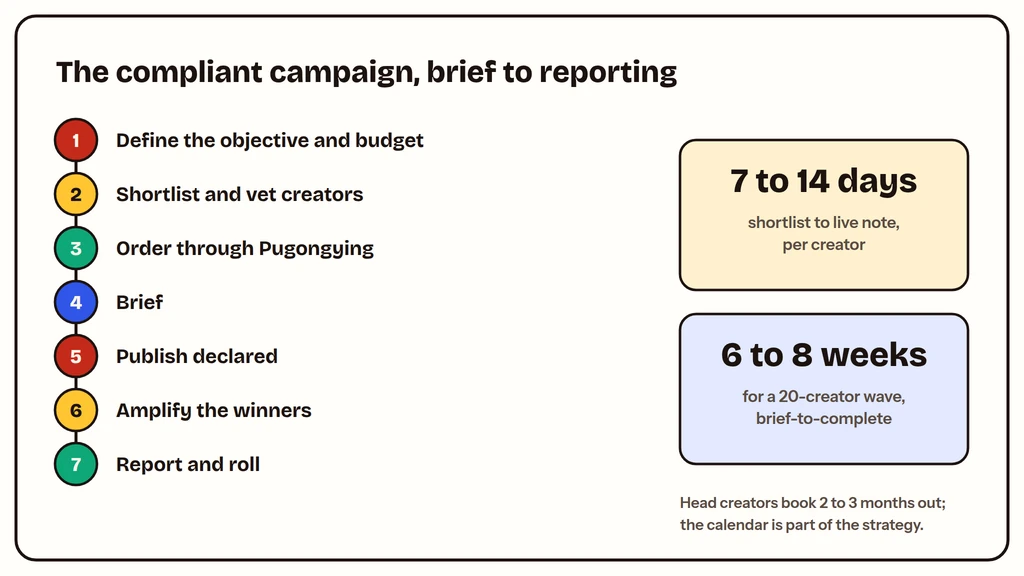
- Define the objective and budget. Use the objective map above, then cost it against the worked scenarios.
- Shortlist and vet creators. Data over follower counts; the working process, tools and scorecard live in our creator-finding guide.
- Order through Pugongying. The ordering entity must match or be affiliated with the trademark holder, so the account and trademark chain from verification matter here. A claimed brand also receives inbound: creators searching for brands to pitch find claimed profiles, which quietly improves your negotiating position.
- Brief. Write for the creator's voice, attach the banned-claims list (no superlatives, no therapeutic implications), and use the platform's content co-editing feature to align drafts before publication. Contracts run bilingual, with portrait-rights term and usage scope explicit. One dispute pattern to pre-empt: the platform withholds creator income tax on declared deals, so agree upfront whether quotes are gross or take-home.
- Publish declared. The note carries its cooperation label and the platform's data reporting starts. Stagger the wave over two to three weeks rather than dropping every note in one day: simultaneous publication reads as a campaign to users and algorithm alike, and it wastes the chance to adjust later notes on early data.
- Amplify the winners. Covered below, because skipping it is the single most expensive habit in the market.
- Report and roll. Metrics by objective, then re-book the creators the data liked. Re-booking is where campaign economics improve: known creators skip the vetting cost, negotiate as partners, and their audiences recognize the brand from the first wave.
Timeline expectation for the whole loop: shortlist to live note averages 7 to 14 days per creator, and complex productions need 21, so a 20-creator wave with vetting takes six to eight weeks brief-to-complete. Head creators book two to three months out, and peak windows carry rush premiums; the calendar is part of the strategy, not an afterthought.
Compliance and the cost of skipping it
Undeclared commercial notes get system-flagged, typically within about 48 hours of posting, then suppressed toward followers-only reach with brand-search placement gone. Accumulated violations trigger suspension of commercial features and account demotion rather than outright bans (2025 community convention). The enforcement is AI plus human review, and it does not need a product link to fire: obvious seeding with a brand interest reads as commercial content.
What declaration buys for its 10% service fee (before tax, in force since July 2025 per the platform's official fee notice): the contract, the campaign data, and the compliance cover that keeps the note alive and rankable. Heating declared content carries its own 5% service fee line, worth knowing when amplification enters the budget. The full baobei-versus-undeclared economics, including why the "cheaper" route costs 1.2 to 1.4x less on paper and more in practice, sit on the cost page.
Compliance has a creative dimension too, and it catches Western teams twice. First, the claims layer: 最 ("the most"), "No. 1" and efficacy promises die in creator notes exactly as they do in ads. Second, the aesthetic layer: Western-style hard product photography, the white-background pack shot your brand book loves, reads as advertising to RED users and gets rejected by the audience even when review passes it. Localized, scene-based shooting is the norm, and briefs that fight it buy prettier notes that sell less.
Measurement, amplification and attribution
Measure by the objective you picked, and never leave winners unamplified. The metric map: awareness campaigns read reach quality and save rates; branded-search lift is the seeding KPI and the one we weight most; launches read engagement quality plus search movement; store campaigns read store entry and closed-loop conversion.
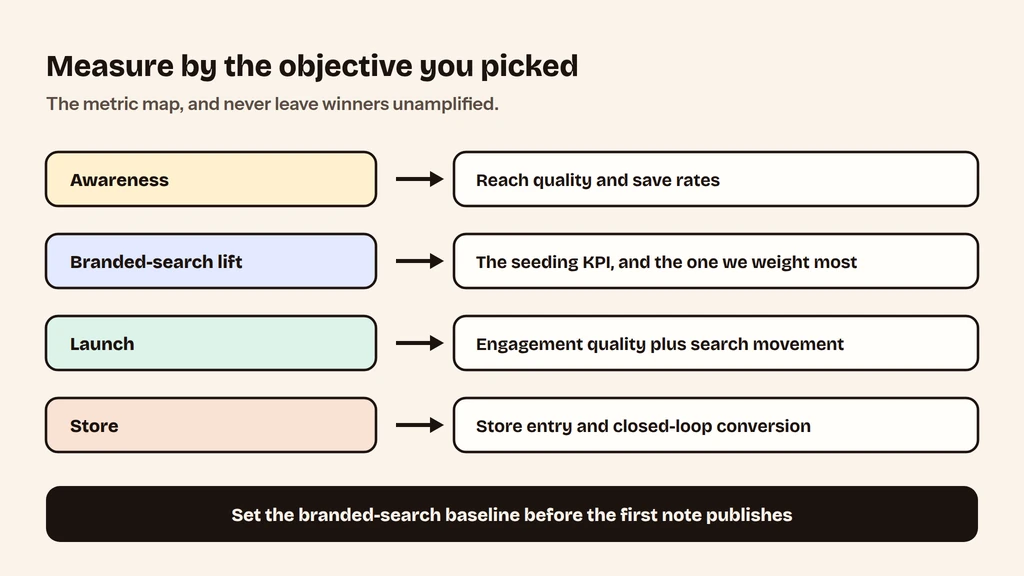
Two practical notes on reading the data. First, Pugongying's campaign reporting covers the declared notes, but branded-search movement lives outside it, in the platform's search tooling or your agency's tracking; set that baseline before the first note publishes or the lift has nothing to be measured against. Second, weight comment quality alongside saves: a note collecting real usage questions ("does this work on sensitive skin?") is generating purchase research in public, and those threads keep converting readers long after the campaign closes.
The amplification rule deserves its own sentence, because the waste pattern is everywhere: brands run creator campaigns and Juguang campaigns as separate line items, and the winning creator notes never get heated into the feed at scale. Creator content plus paid amplification is one system; run separately, both underperform, and the creator budget's best output expires unused.
On attribution, the honest position: seeding is assisted conversion. Judge it on branded-search lift and durable note rankings over quarters, not on last-click ROI in week two. Expecting notes to behave like performance ads is how good campaigns get cancelled early, usually right before the search curve was about to pay for them.
We can help
If the seven-stage workflow and the compliance layer read as more operations than your team signed up for, that's the honest picture of creator marketing here: the strategy is the easy half. We build the mixes, run the Pugongying orders, carry the Chinese-language briefing and negotiation, and wire the winners into paid amplification so the catalog compounds instead of expiring. Ask for a creator campaign plan: objective, mix, creator counts, all-in budget, and the measurement baseline set before the first note goes live.
FAQ: running creator campaigns
How long should a campaign run before evaluating it?
Give a seeding wave six to eight weeks: two for publication, four to six for search positions and save curves to settle. Judging at two weeks reads noise.
Should we use an MCN or work with creators directly?
For a first campaign run from abroad, managed beats direct: MCNs and agencies absorb the Chinese-language coordination and the delivery risk. Direct deals make sense once you have an in-house operator and re-book known creators.
Can an overseas team manage this without Chinese-speaking staff?
Strategy yes, execution no. Briefs, negotiations, drafts and the platform itself run in Chinese, so plan on an agency, an MCN, or a Chinese-speaking hire from day one.
Who owns the creator content after publication?
The creator, unless usage rights were bought. Repurposing notes in ads, stores or other channels is a rider negotiated upfront, and it's cheaper before the note performs than after.
Can creator notes be reused as ads?
Yes, and they should be: heating winning declared notes through Juguang is the standard amplification path. Confirm the usage rights and note the separate heating service fee.