Xiaohongshu Ads Manager: Inside Juguang, RED's Ad Platform (2026)
TLDR
Xiaohongshu's ads manager is Juguang (聚光): Chinese-only, no official English version as of mid-2026, structured as account, campaign, unit, creative. Opening an account takes a verified professional account plus the brand's document chain, review runs 1 to 3 working days, and there is no deposit, only a first-recharge floor. This is the walkthrough from login to first optimization, the way an operator actually clicks through it.
Search for "Xiaohongshu ads manager" and you'll find plenty of articles about advertising on RED and almost nothing about the tool itself. This page is the missing documentation. Route choice, costs, and strategy live in our Xiaohongshu advertising guide; this one stays inside the tool. We run Juguang daily for overseas brands, so each step below matches what the screen actually shows, with the foreign-brand traps marked where they sit in the flow.
Want the account opened and run for you? Our RED ads management service covers the whole chain.
Access and orientation
Juguang is a desktop browser tool, reached through Xiaohongshu's business portal or the professional-account center in the app; there is no full-featured mobile version worth running a campaign from. The interface is entirely Chinese. No official English language pack exists as of mid-2026 (verified on a live account, July 2026), and every term below appears on screen in Chinese only.
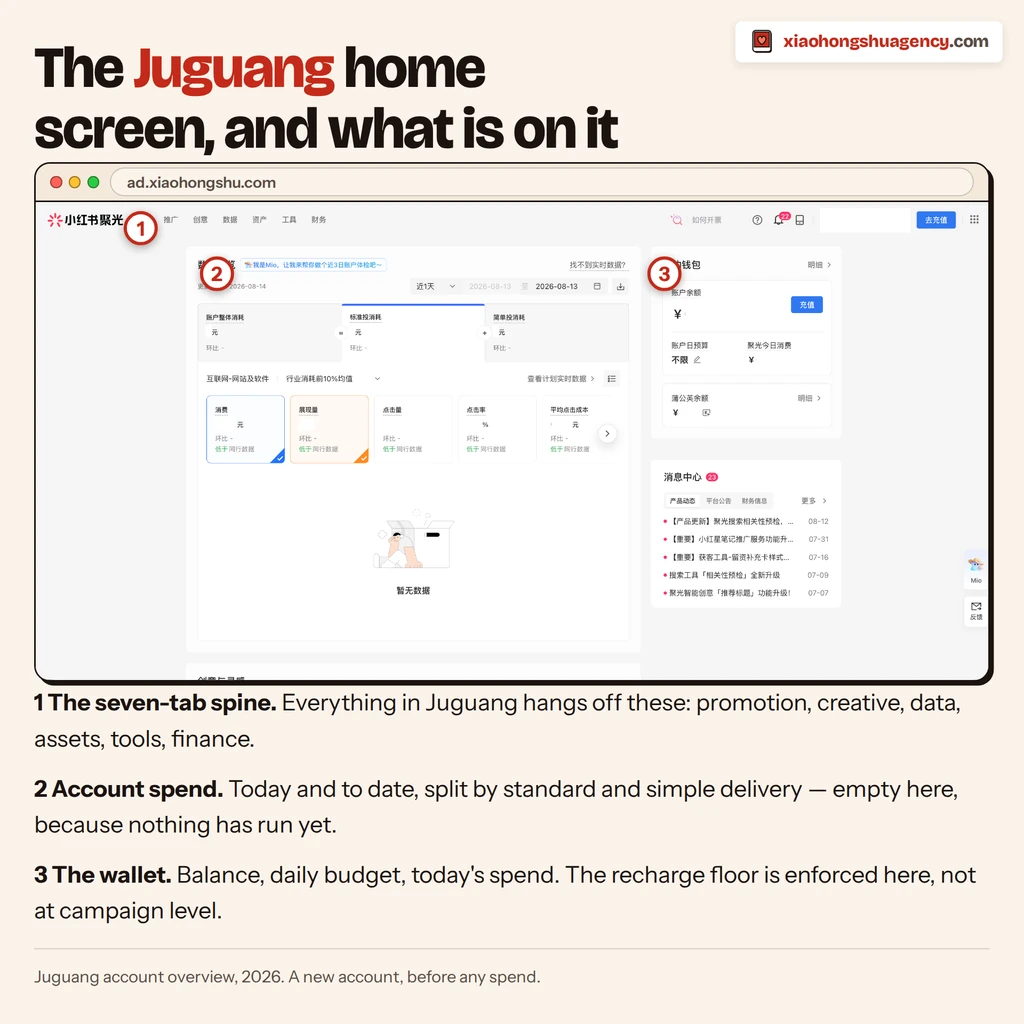
Five terms cover most of the interface: 账户 (account), 计划 (campaign), 单元 (unit), 创意 (creative), 审核 (review). Learn those five and the menus stop being a wall. The screenshots through this guide carry English annotation for everything else, which is also how we train client teams who want read-access to their own accounts without a Mandarin course first.
Step 1: Open the account
The chain runs verification, documents, review, first recharge. With clean files the review clears in 1 to 3 working days; holidays stretch it.
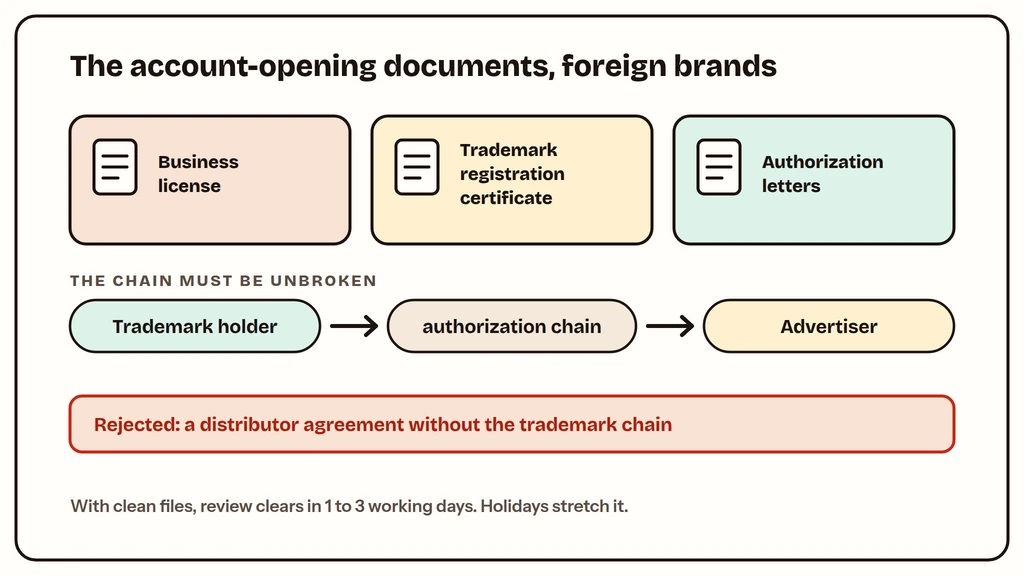
The documents: business license, trademark registration certificate, and authorization letters forming an unbroken chain from the trademark holder to the advertiser. A distributor agreement without the trademark chain gets rejected. The account itself starts from a verified professional account, covered in our verification guide.
Two money facts foreign teams get wrong. First, ad accounts carry no deposit; the 保证金 you'll read about elsewhere is a store concept. What exists is a first-recharge floor, around 5,000 RMB at platform level, with agency cross-border packages typically setting 10,000 to 20,000 RMB, per current policy and your agreement. Second, recharge runs through licensed processors (PingPong, LianLian, Airwallex) or an official reseller; foreign cards fail at this step. The fapiao issues to the verified China-side entity, never your overseas HQ, so warn your finance team before the first invoice, not after.
One structural choice at opening: Juguang splits into performance ad accounts and brand ad accounts. Foreign brands almost always start on performance. Brand accounts unlock brand zone and hot-search placements but demand higher pre-charges and a direct contract, so treat them as a later upgrade, not the default.
Step 2: Understand the hierarchy
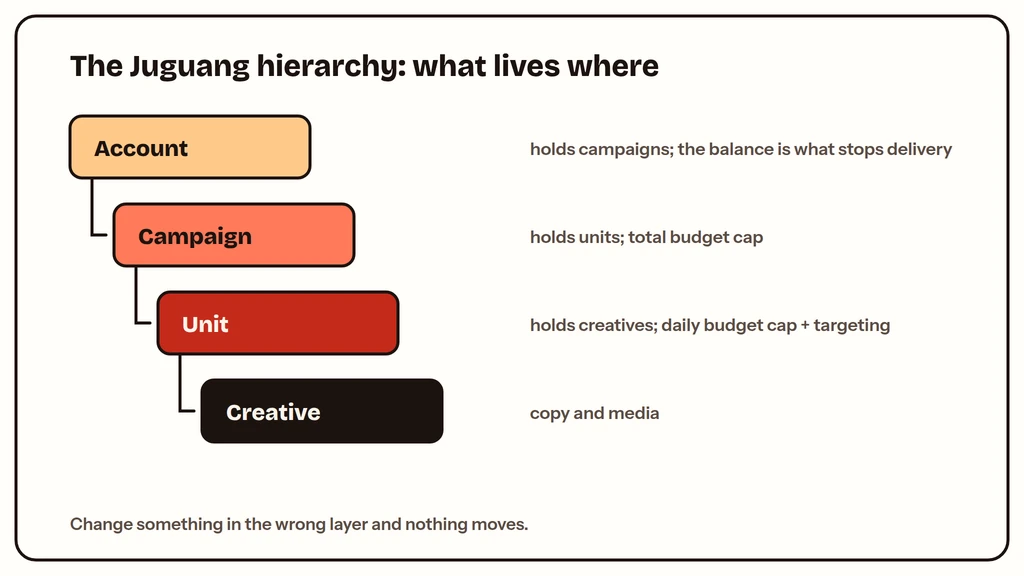
Everything in Juguang hangs off four levels: account holds campaigns, campaigns hold units, units hold creatives. Budget lives at campaign and unit level, targeting lives at unit level, copy and media live at creative level. Change something in the wrong layer and you'll wonder why nothing moved.
Step 3: Create a campaign
Campaign creation opens with the objective picker. Five objectives exist as of mid-2026: brand exposure, click and engagement, product sales, direct-message lead generation, and livestream traffic.
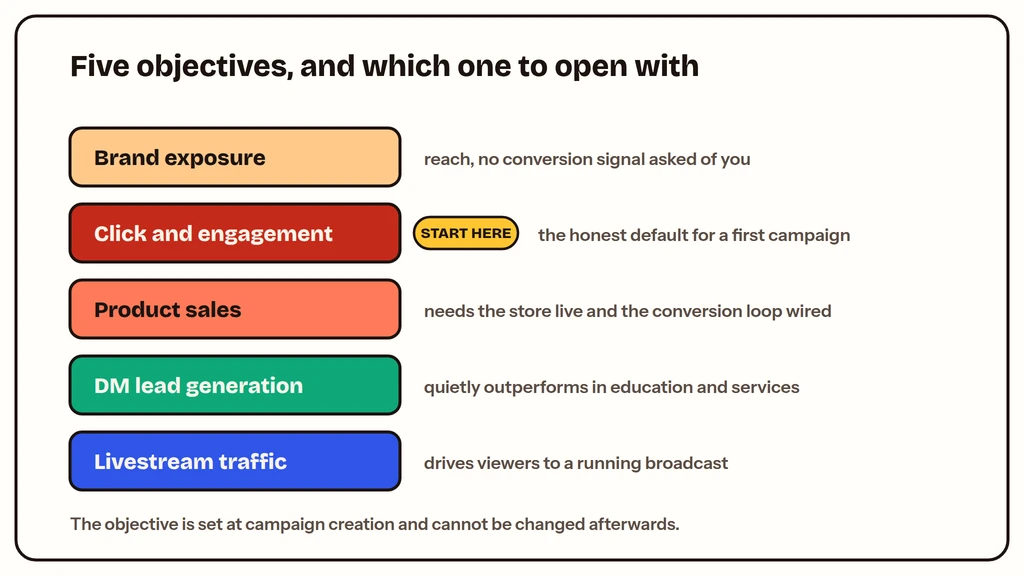
Where each objective actually delivers, from our account work: click and engagement is the honest default for a first campaign, because it feeds the algorithm signal without demanding conversion tracking you haven't built yet. Product sales needs the store live and the conversion loop wired. DM lead generation quietly outperforms for high-consideration categories like education and services, where the sale closes in conversation rather than in cart.
Bidding offers manual CPC/CPM or OCPX smart bidding, joined in late 2025 by an all-site promotion mode (全站推广). The automation lowers the operating burden, and it costs you visibility: reporting under the automated modes shows less of what the system actually did with your money. My take: run manual until you have two or three weeks of baseline data, then let OCPX take over with a known reference point. An automated mode adopted on day one leaves you nothing to compare it against.
Budgets set daily caps at unit level and total caps at campaign level. Set both. A campaign cap alone lets one strong unit starve its siblings; unit caps alone let a broken campaign spend to its ceiling overnight. The floor mechanics from step 1 apply here too: the account balance, not the campaign budget, is what actually stops delivery when it runs dry.
Step 4: Set targeting
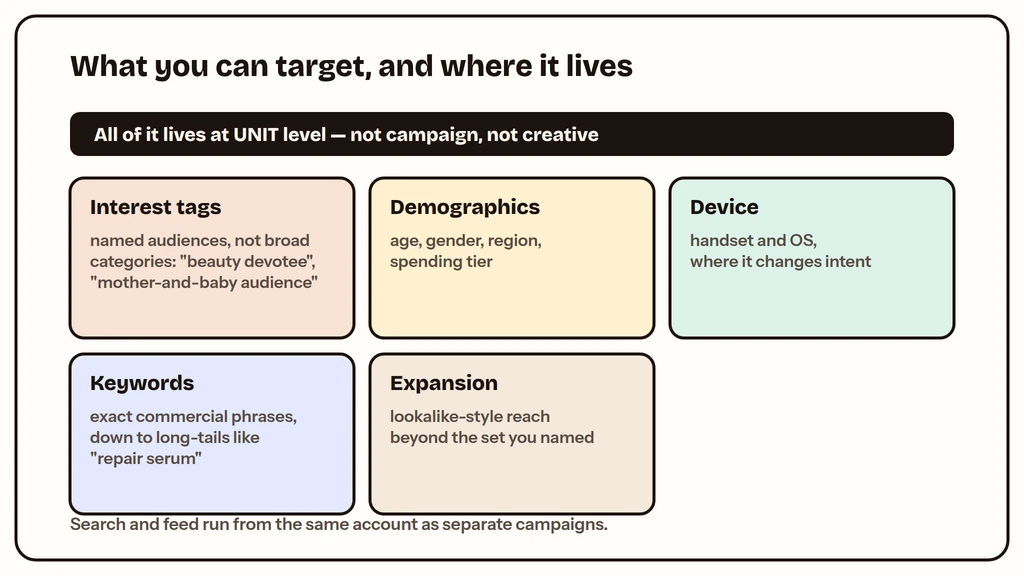
Targeting at unit level covers interest tags, demographics, device, keywords, and lookalike-style expansion. The interest taxonomy is concrete: tags like 美妆控 (beauty devotee) or 母婴人群 (mother-and-baby audience) rather than broad categories. On search placement, keyword targeting locks exact commercial phrases, down to long-tails like 修护精华 (repair serum), and search and feed placements run from the same account as separate campaigns.
Step 5: Upload creative and pass review
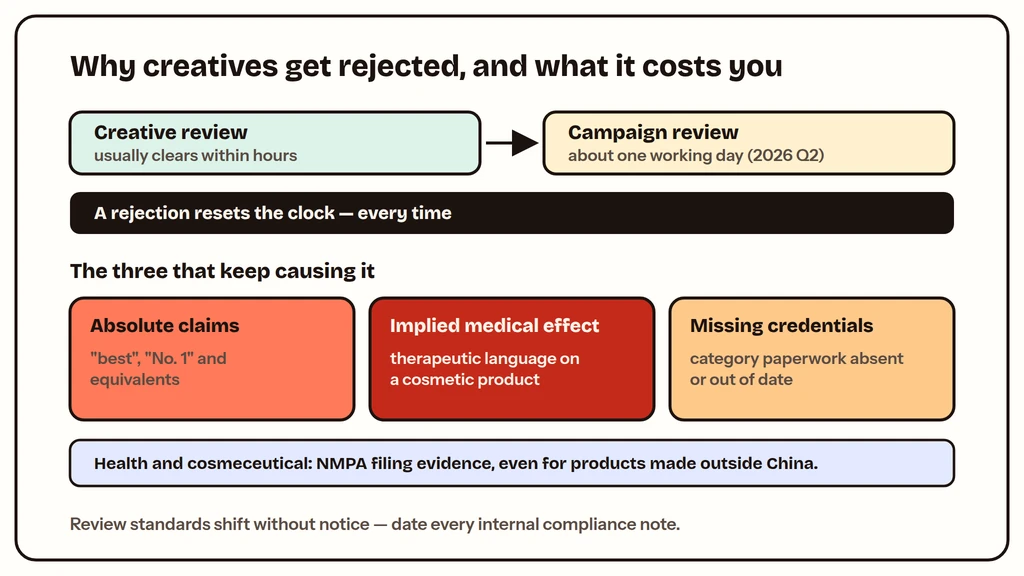
Creative upload takes the note format, cover image, and copy. Then review, the step that catches foreign teams: creative review usually clears within hours and campaign review takes about one working day (2026 Q2 observations), but a rejection resets the clock each time.
The recurring rejection causes: absolute claims (最, "No. 1" and equivalents), implied medical or therapeutic effects, and missing category credentials. Health and cosmeceutical brands have faced tighter demands since 2025, including NMPA filing evidence even for products made outside China. Review standards shift without notice, so date every internal compliance note to the day you submitted. Rejected creatives are edited and resubmitted from the review status screen, which is also where the rejection reason appears, in Chinese.
Step 6: Monitor and optimize
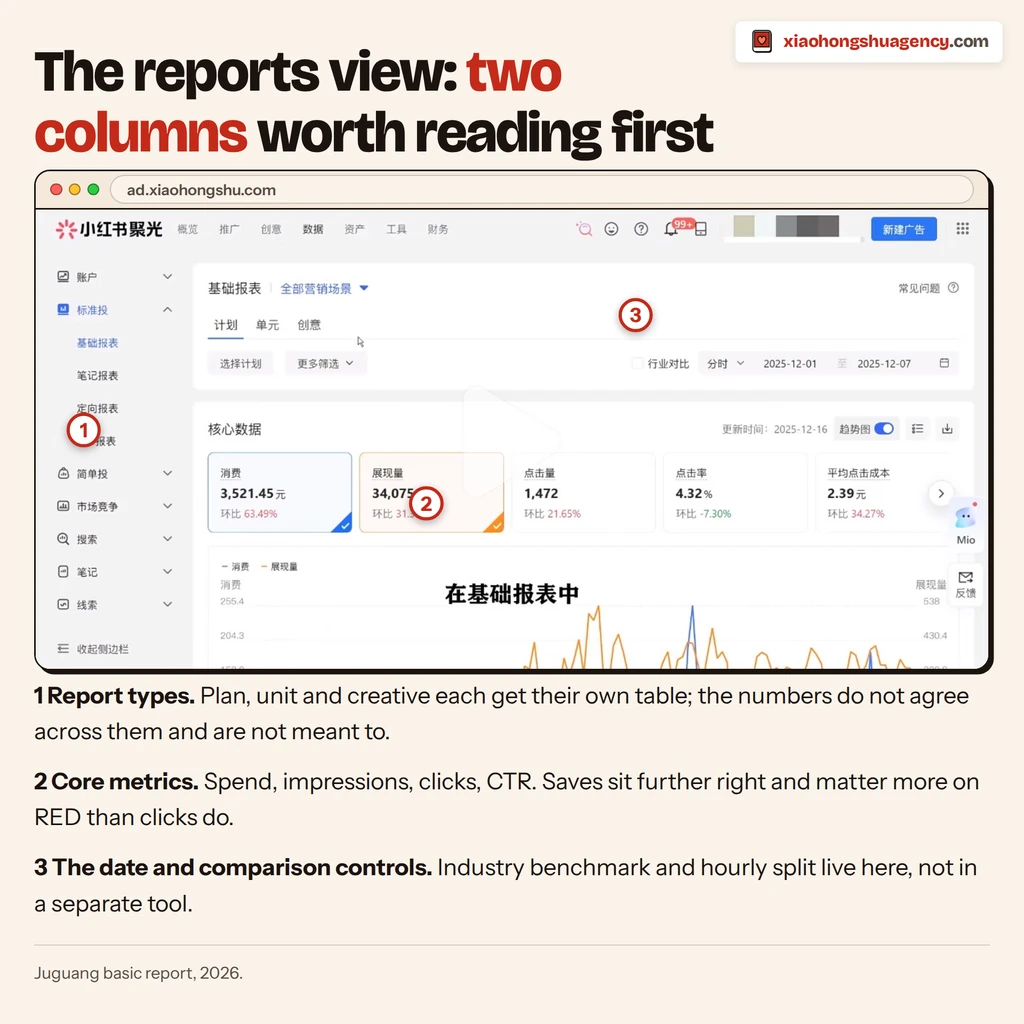
The reports section (报表) is where the account earns its keep. The columns that matter first: spend, impressions, CTR, engagement cost, and conversion events if you've wired tracking. RED adds platform-specific columns worth watching from week one: note interactions (likes, saves, comments driven by the ad) and search-term data on search campaigns, because saves in particular predict whether a creative will hold up when you scale it. A note that gets saved is being filed for a future purchase; a note that only gets clicked is being browsed.
Conversion tracking runs through Xiaohongshu's conversion tools and needs technical integration on your side, so put it on the post-approval checklist rather than discovering the gap mid-campaign. Until it's wired, product-sales campaigns are flying blind and the platform optimizes toward clicks it can't value.
The post-approval checklist we run for every new account: verify conversion tracking, build the audience packs, and load a pre-tested bank of compliant Chinese copy so a rejection never leaves a campaign dark while new creative crawls through review.
Optimization order: creative first, bids second, audience third. Creative moves the numbers most on RED because the feed rewards native-looking notes, and it's the variable review lets you iterate fastest. And remember the OCPX caveat from step 3: the more automation you hand over, the less the reports tell you about why performance changed.
Agency vs in-house: the real cost
| In-house | Agency | |
|---|---|---|
| Visible cost | Media spend only | Media spend + fee or margin |
| Hidden cost | Chinese-speaking ops hire, translation, test burn, review resubmissions, payment setup | Less account intuition transfers to your team |
| Speed to first clean launch | Weeks, sometimes months | Days once documents clear |
The honest version: without an operator who reads Chinese and knows domestic ad law, one banned word can stall a plan that burns thousands of RMB a day. That single failure mode is why most foreign brands delegate, and it's what our ads management service exists to absorb. Budget context for either path sits in our cost breakdown.
We can help
If the hierarchy, the review loop, and the Chinese-only rejection notes read like a lot of operational surface, that's because they are. We open and run Juguang accounts for overseas brands with the document chain, payment route, and compliant-copy bank already standing. Ask us for a Juguang account plan and we'll map your category's opening requirements, timeline, and first-campaign structure before you commit anything.
FAQ: Juguang in practice
Is there an English version of Xiaohongshu ads manager?
No. Juguang has no official English interface or language pack as of mid-2026. Teams either operate in Chinese, run browser translation with the risks that carries, or delegate to an operator who reads the interface natively.
Can an agency run our existing Juguang account?
Yes. Operator access can be granted on an account your entity owns, which keeps the asset yours while the day-to-day runs elsewhere. Confirm role scopes with your agency at handover.
Why is the recharge option unavailable on our account?
Usually because the payment route was never established. Foreign cards fail, so recharge works only once a licensed processor relationship or reseller arrangement is in place.
Where do rejected ads get fixed?
In the review status screen, which lists each creative with its rejection reason. Edit the creative there and resubmit; the review clock restarts on each submission.
Can search and feed ads run from one account?
Yes. Both placements live in the same Juguang account as separate campaigns, each with its own targeting and budget.