Xiaohongshu Account Verification for Foreign Brands: The 2026 Process
TLDR
Foreign companies verify a Xiaohongshu account through the professional account (专业号) system using their home-country business license with a stamped Chinese translation; notarization is only demanded if review challenges the file. The fee is 600 RMB per year (unchanged since 2022) and clean applications clear in 1 to 3 working days as of July 2026. Verification unlocks the commercial layer: ads, creator deals, store eligibility, and brand tools. Brand claiming (品牌认领) is a separate second step, and skipping it leaves your brand name claimable by someone else.
Most English guides to Xiaohongshu verification describe a system that no longer exists. The old enterprise-account tiers were retired when the platform moved everything to the professional account framework, and the overseas path has its own document chain and its own hidden prerequisites. This is the current process, written from the applications we file for overseas brands, with the rejection causes and the one step almost everyone skips.
Want the application filed for you? Our setup team handles verification end to end.
Account types, eligibility, and what you unlock
Two account types exist today: personal and professional. Everything commercial sits behind verified professional status.
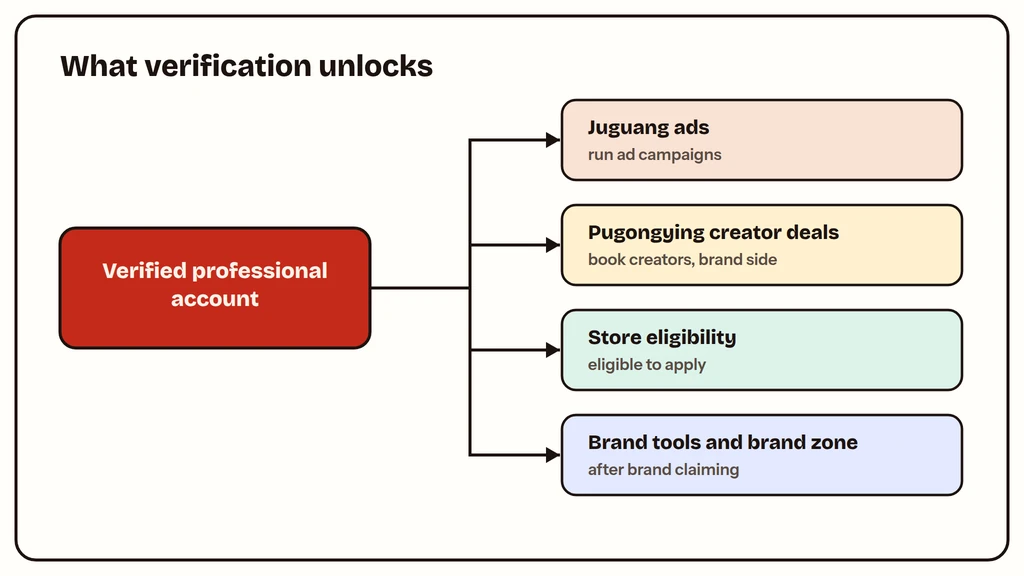
| Personal account | Verified professional account | |
|---|---|---|
| Post product links | No | Yes, store and product notes |
| Run Juguang ads | No | Yes |
| Book creators via Pugongying | No | Yes, brand side |
| Open a store | No | Eligible to apply |
| Brand tools and brand zone | No | After brand claiming |
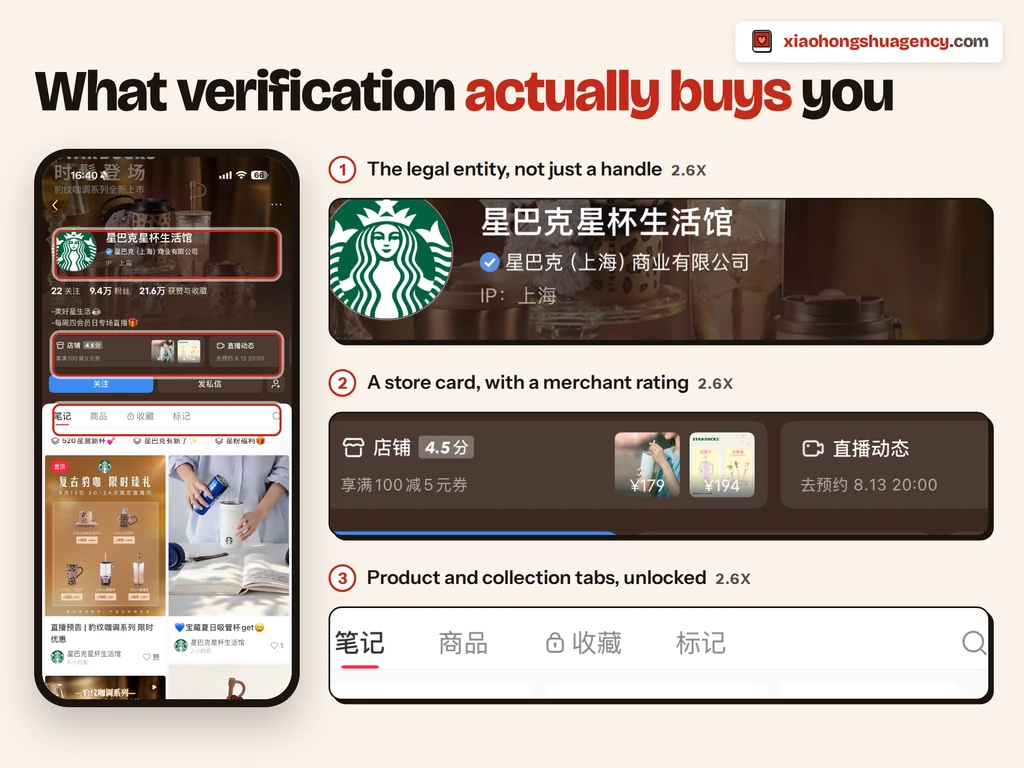
The verified badge does user-facing work too. A verified professional profile shows the entity name and badge on the account page, which matters on a platform where users routinely check who's behind a brand account before trusting its notes. Unverified brand-looking accounts read as gray-market resellers, and RED users treat them accordingly.
Most overseas consumer brands are eligible. The exceptions matter: since Q3 2025 the platform screens overseas applications by business category, and some industries, cross-border medical and finance among them, are simply not open for overseas verification regardless of paperwork. Check the category gate before investing in the file. We keep a current read on which categories clear, so ask before you assemble documents if yours sits anywhere near the line.
Reading an older guide? If it mentions "enterprise accounts" or blue-V tiers, it describes the retired system. Only personal and professional accounts exist now.
The verification process, step by step
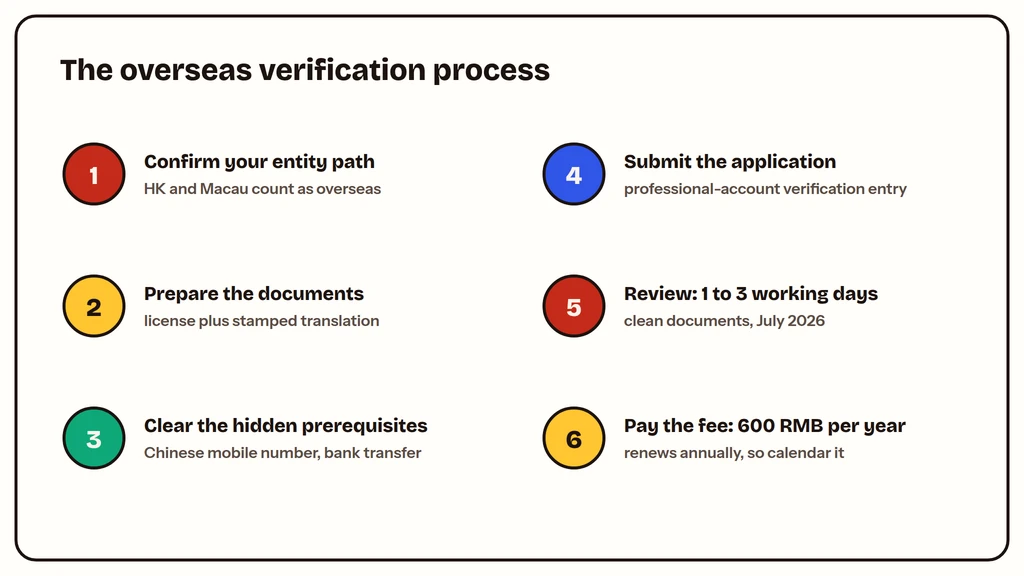
- Confirm your entity path. Overseas companies use the overseas channel. That includes Hong Kong and Macau entities, and this is where the first trap sits: HK companies actually get rejected more often, flagged as having no real domestic operation, unless the file proves the relationship between the brand and the HK entity. A Hong Kong shell does not dodge the "foreign" label.
- Prepare the documents. The chain is detailed in the next section.
- Clear the hidden prerequisites. The account administrator must bind a Chinese mobile number; overseas founders solve this through local staff or their agency. Some corporate applicants are also asked to verify their bank account by receiving a small RMB test transfer, which overseas accounts can rarely receive. Agency-fronted verification is the standard workaround, and it's better arranged before the application than discovered mid-review.
- Submit through the professional-account verification entry.
- Review: 1 to 3 working days with clean documents (July 2026), longer over holidays.
- Pay the fee: 600 RMB per year, via domestic payment rails, which in practice means the agency pays on the brand's behalf. The fee has held since 2022, but treat it as "per the current official notice." Verification renews annually; a lapse drops the verified status, so calendar it.
The overseas document chain
The core file: your home-country business license (original, in English or your local language) plus a Chinese translation stamped by a translation company. Full consular notarization is not the default requirement; it gets demanded only when review questions the file. Where brand claiming will follow, add the trademark registration certificate and authorization letters connecting the trademark holder to the applying entity.
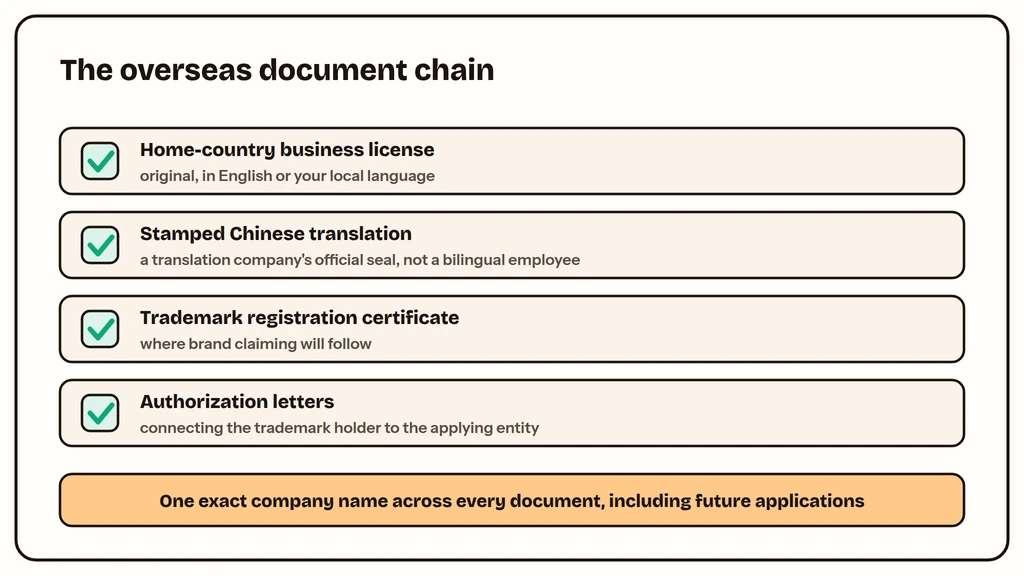
The silent killer in this chain is consistency. The company name must match, character for character, across license, translation, trademark record, and application form. We've seen more files stall on a translated name variant than on any missing document: "Acme Labs Ltd." on the license, "Acme Laboratories" in the translation, and the review team reads two different companies. Pick one Chinese rendering of your company name on day one and use it everywhere, including future store and ad-account applications, which reuse this same chain.
On the translation itself: the stamp matters more than the translator. Review wants a translation company's official seal on the Chinese version, not a bilingual employee's best effort. It's a cheap, fast service in any Chinese city, and your agency will have a standing provider. Requirements shift, so confirm the current checklist at submission.
Rejections: causes and fixes
Five causes cover most rejections we see, and each has a defined fix:
| Rejection cause | Fix |
|---|---|
| Name mismatch across documents | Align every document to one exact name, resubmit |
| Expired or stale documents | Refresh the license or certificate, resubmit |
| Broken authorization chain | Add the missing link from holder to applicant |
| Category mismatch or gated industry | Recheck the category screening; some industries have no overseas path |
| No verifiable public brand presence | Establish the footprint (site, registries) before reapplying |
Resubmission is normal and doesn't poison the file. Two rejections on the same cause is the signal to hand the file to someone who does this weekly.
Brand claiming: the separate step everyone skips
Account verification and brand claiming are two different procedures, and finishing the first does not touch the second. Verification proves your company; claiming (品牌认领) registers your brand with the platform, and it's initiated from an already-verified professional account using the same trademark chain.
In 1994, a Wired journalist registered mcdonalds.com before McDonald's got around to it, and the company had to negotiate to recover its own name. Different registry, same rule: the name goes to whoever files, not whoever is famous. An unclaimed brand on Xiaohongshu is exposed the same way, and beyond squatting risk, unclaimed brands can't access the brand zone, protection tooling, or proper discoverability when creators search for brands to work with.
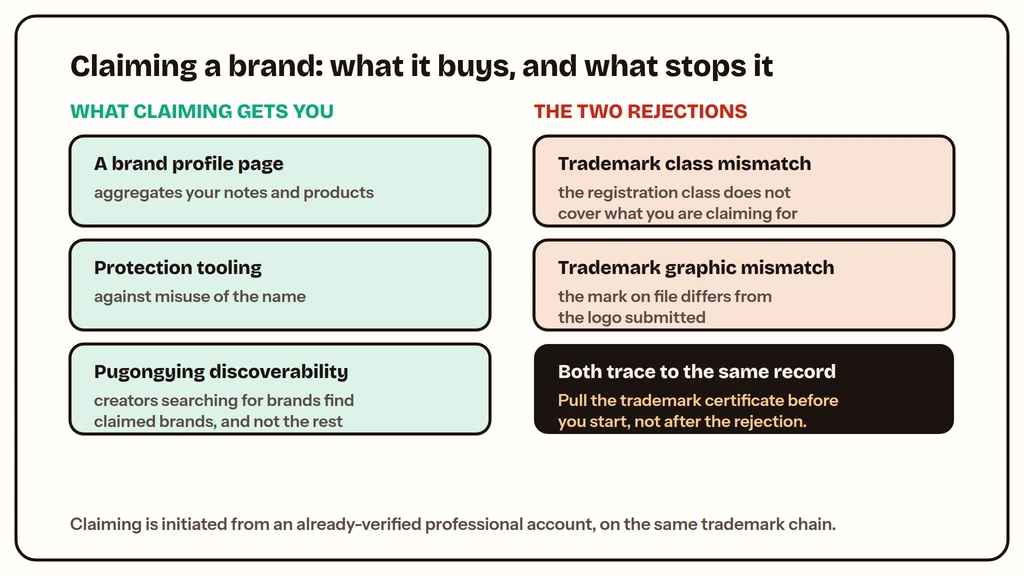
The two claiming rejections we see most: trademark class mismatch (your registration class doesn't cover the products you're claiming for) and trademark graphic mismatch (the mark on file differs from the logo submitted). Both trace back to the trademark record, so pull the certificate before you start, not after the rejection.
What a claimed brand actually gets: the brand profile page that aggregates your notes and products, access to protection tooling against misuse of the name, and discoverability inside Pugongying, where creators searching for brands to pitch find claimed brands and not the rest. That last one has a quiet commercial effect: creators bring inbound collaboration offers to claimed brands, which changes the negotiating table described in our KOL cost guide.
Post-approval checklist
The order of operations once the badge lands:
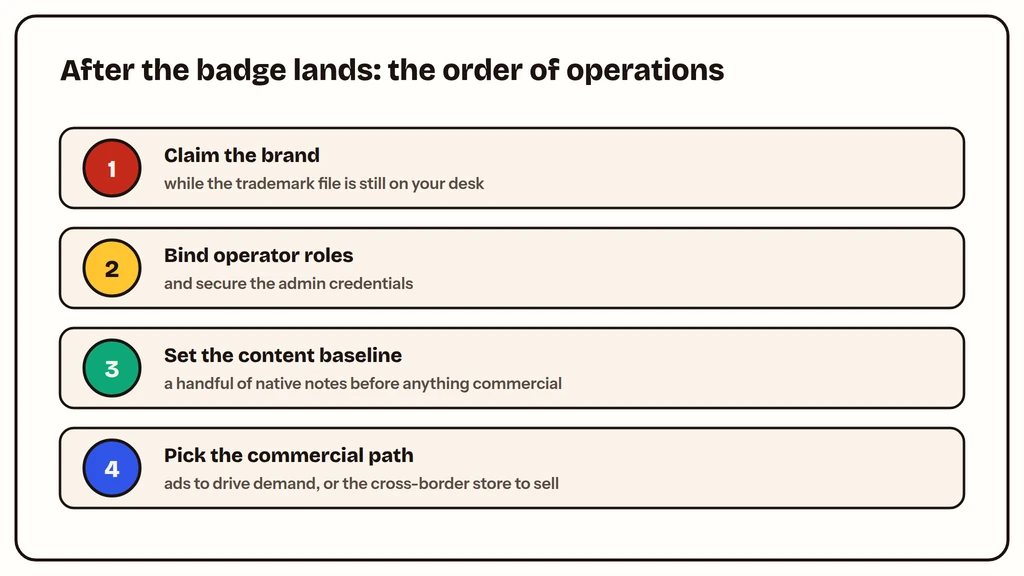
- Claim the brand while the trademark file is still on your desk.
- Bind operator roles and secure the admin credentials.
- Set the content baseline: a handful of native notes before anything commercial.
- Then pick the commercial path: ads if you're driving demand, or the cross-border store if you're ready to sell. Store setup strategy sits in our selling on Xiaohongshu guide.
We can help
Between the Chinese mobile number, the bank micro-transfer, and the name-consistency trap, overseas verification fails on logistics more than on eligibility. We file these applications with the document chain pre-checked, the domestic prerequisites covered, and brand claiming bundled in the same pass, so the account arrives commercial-ready. Ask us to run your setup and we'll confirm your category gate and name chain before anything is submitted.
FAQ: verification in practice
Is account verification the same as brand verification?
No. Account verification proves the company behind the account; brand claiming registers the brand itself and unlocks the brand tools. They're separate procedures using overlapping documents, and both need doing.
Can one overseas company verify accounts for multiple brands?
The account binds to the verified entity, and each brand's claim rides on its own trademark chain. Multi-brand structures work, but map the account-to-brand architecture with whoever files, because restructuring later is painful.
What happens after a rejection?
You fix the flagged cause and resubmit; rejection doesn't blacklist the file. Match the fix to the cause using the table above, and escalate to an agency after two failures on the same point.
Must authorization letters come from the trademark owner directly?
The chain must start at the holder and reach the applicant with no missing link. A distributor's letter alone doesn't substitute for the holder's authorization.
Can a distributor claim a brand it doesn’t own?
Not in its own right. Claiming follows the trademark, so a distributor needs the holder's authorization chain to claim on the brand's behalf, and the claim serves the trademark owner's brand, not the distributor.