Xiaohongshu Ads Cost in 2026: CPC Ranges, Minimums and a 90-Day Budget
TLDR
The five answers up front. Cheapest viable test: a few hundred RMB of Shutiao boosting on organic notes. A practical 90-day entry test: 15,000 to 40,000 RMB all-in including creative. Typical media rates in 2026 H1: feed CPC 0.8 to 3 RMB (medians around 0.9 to 1.5), lifestyle CPM 40 to 80, search CPC 1 to 3 with beauty pushing 4 to 6 (median about 2.5). No deposit exists on ad accounts, but the first-recharge floor (about 5,000 RMB at platform level, 10,000 to 20,000 in agency cross-border packages) is the de facto entry ticket. And agency quotes usually exclude media unless they say otherwise: ask which lines a quote covers before comparing anything.
Most "Xiaohongshu advertising cost" content hands you a rate and wishes you luck. Rates are a third of the answer: the budget you'll actually approve includes creative production, agency fees, currency friction, and enough media to produce a real signal. This page carries the current ranges, the fee stack around them, and three fully worked 90-day budgets you can lift into a planning deck. How the platform itself works lives in the advertising guide and the Juguang walkthrough; this page owns the money.
Want a budget built for your category? Our RED ads team prices it with you.
The cost table: 2026 rates
The ranges, then what they mean. These are 2026 first-half industry-tested figures from agency disclosures and account data; they move with competition and season, so treat the medians as planning anchors.
| Placement | 2026 H1 range | Median / note |
|---|---|---|
| Feed ads (CPC) | 0.8 to 3 RMB | Median 0.9 to 1.5 |
| Feed / lifestyle (CPM) | 40 to 80 RMB | Vertical-dependent |
| Search ads (CPC) | 1 to 3 RMB general | Beauty to 4-6, median ~2.5; 3C ~1.8 |
| Shutiao boost (CPM) | 8 to 12 RMB per 1,000 impressions | Organic notes only |
| Opening screen / takeover | CPM 40 to 60, impression-block buys | City-level minimums ~150,000 RMB (Beijing/Shanghai); published agency benchmarks |
Two footnotes that save money. Beauty and personal care bid above every range here; budget the top of the band. And Shutiao heats organic notes only: content the system reads as commercial gets its heating refused, so Shutiao is a testing tool for native-reading notes, not a discount ad channel. The takeover row is context, not a recommendation; almost nobody searching this query is buying brand-takeover inventory, and the money is better spent below.
The floor vs a viable test: two different numbers
The first-recharge floor opens the account: about 5,000 RMB at platform level, reseller-negotiable, with agency cross-border packages typically setting 10,000 to 20,000 as the first top-up (per current policy and your agreement). No deposit exists on ad accounts, but don't read that as zero entry cost: the floor is the entry ticket by another name.
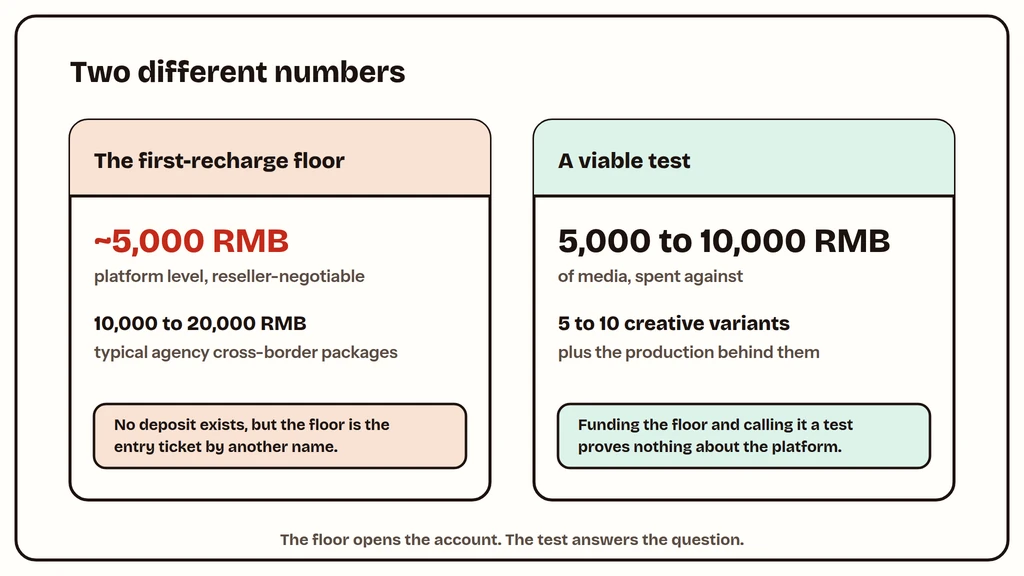
A viable test is a separate, larger number: 5,000 to 10,000 RMB of media, spent against enough creative variants to mean something (next section), plus the production behind them. Funding the floor and calling it a test is the most common way brands "prove" the platform doesn't work.
Juguang Lite deserves a tradeoff framing here, not a recommendation: the low-entry version now offers partial keyword recommendations, but still no search-term download, and the reporting gaps compound as spend grows. Fine for a first month; limiting by the third.
Why rates vary: your creative is your credit score
The auction doesn't set your price; your creative quality does. Juguang throttles low-CTR, low-interaction creative, which pushes its effective CPC up until the campaign quietly stops delivering, and rewards native-reading notes with cheaper clicks. The mechanism works like a credit score: two borrowers ask for the same loan and pay different rates based on the score they bring. Two brands bid on the same keyword and pay different CPCs based on the creative they bring.
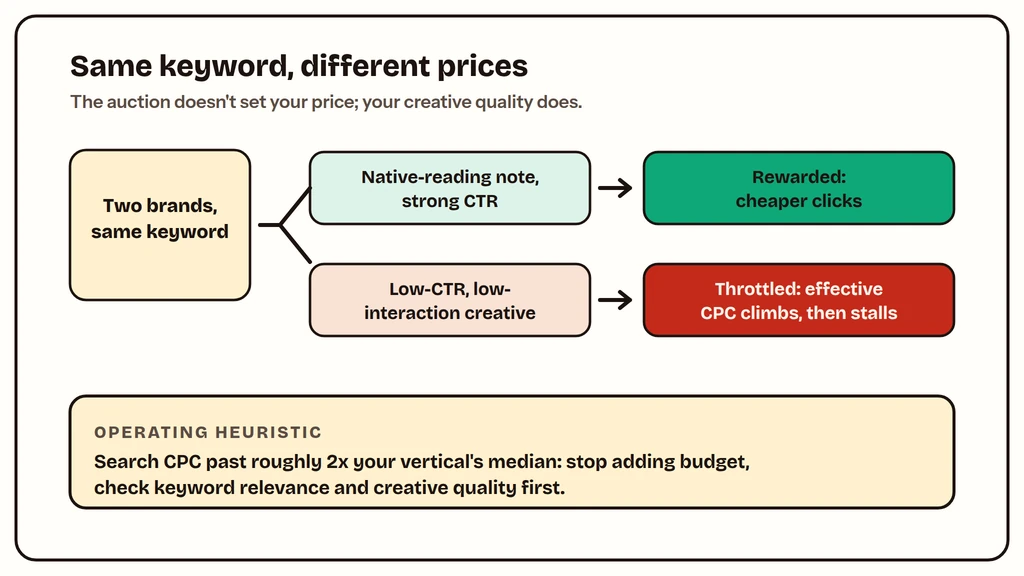
The planning consequence: creative testing sets your cost floor, not the rate card. A 5,000 RMB media test spread over one or two creatives measures those creatives, not the platform; five to ten distinct angles is the minimum for the test to mean anything, and the production cost of those variants belongs in the budget (next section). One operating heuristic worth stealing: when search CPC runs past roughly twice your vertical's median, stop adding budget and check keyword relevance and creative quality first, because past that line you're paying the platform to tell you the ad is bad.
The complete fee stack
Media is one line of four. Comparing agency quotes without knowing which lines they include is how identical campaigns end up "costing" wildly different amounts.
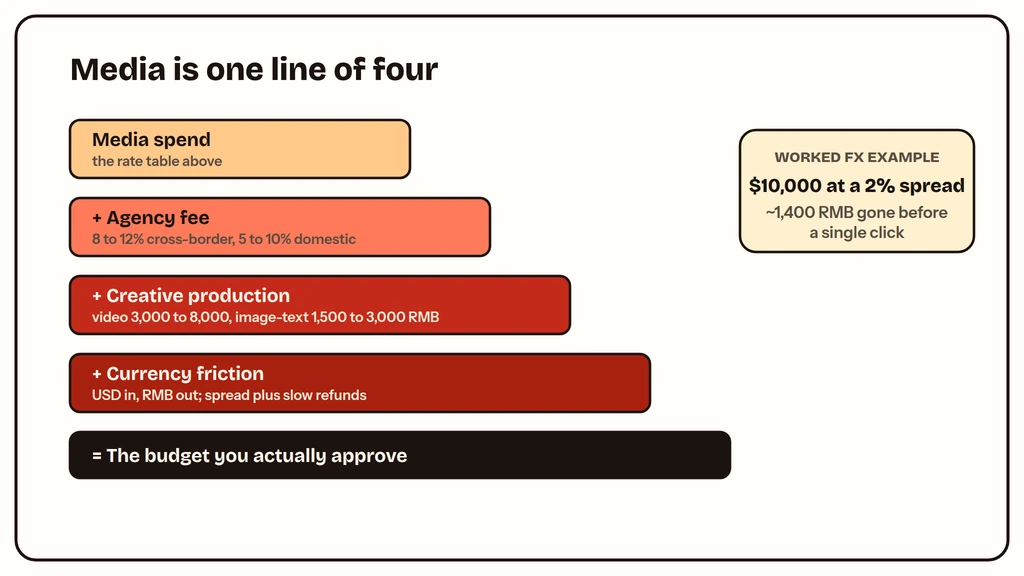
- Media spend. The table above.
- Agency fee. Cross-border brands typically pay 8 to 12% of spend (language, compliance and payment overhead); domestic-only arrangements run 5 to 10%. Fixed monthly fees exist as an alternative; either way, confirm whether creative is included, because it usually isn't.
- Creative production. A localized video runs 3,000 to 8,000 RMB per piece, image-text 1,500 to 3,000 (2026 practitioner figures). At the five-to-ten-variant minimum, production is often the largest line in a first test, and the most commonly omitted from quotes.
- Currency friction. You recharge in USD and spend in RMB. Worked example for the finance team: recharge $10,000 and a 2% processor spread costs about 1,400 RMB before a single click, with unspent balances refunding slowly. Fapiao (invoices) issue to the China-side entity, so plan the reimbursement path too.
Channel context in one honest paragraph: for the same 50,000 RMB, a creator seeding wave often out-produces pure ad spend for brands with no content bank, because the notes keep working after the budget stops. The comparison lives properly in our KOL cost breakdown; the short version is that ads scale what creators prove.
Three worked 90-day budgets
Three plans, all-in, with every line visible. Ranges, not quotes; the disclaimer is that categories and seasons move all of them.
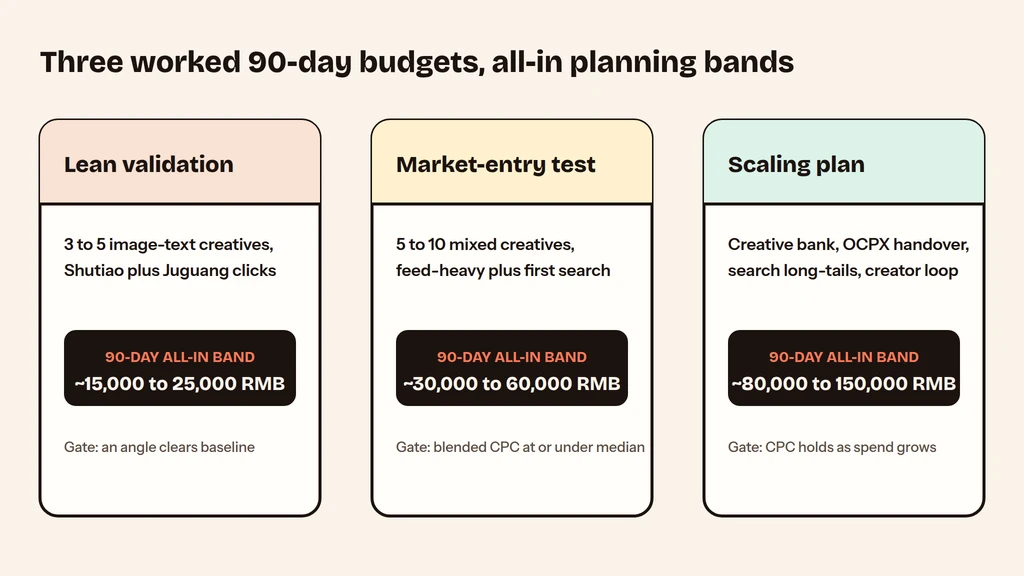
Lean validation, roughly 15,000 to 25,000 RMB all-in. Three to five image-text creatives (5,000 to 12,000 production), a few hundred RMB of Shutiao testing, 5,000 to 8,000 media in Juguang click campaigns on the survivors, agency fee if managed. Excludes: video, search expansion. Buys: a clean read on whether any message angle earns above-baseline saves and CTR. Gate: no angle clears baseline, revise the message, not the spend.
Market-entry test, roughly 30,000 to 60,000 RMB all-in. Five to ten mixed creatives including one or two videos (12,000 to 25,000 production), 12,000 to 25,000 media split feed-heavy with a search campaign on brand plus category terms, agency fee, FX reserve. Buys: statistically honest creative testing plus first search presence. Gate: blended CPC at or under your vertical's median and branded-search movement, then scale; miss both and the next budget goes to creators, not more ads.
Scaling plan, roughly 80,000 to 150,000 RMB all-in. A proven creative bank refreshed monthly, OCPX handover after two to three weeks of manual baseline, search expansion into long-tails, and the creator loop: heating winning declared notes through Juguang (the separate 5% heating service fee applies). Buys: efficient scale with the data to defend it. Gate: CPC holding through spend increases; if efficiency decays faster than spend grows, the creative bank is stale, not the audience.
The 90-day operating plan
The plans above share one calendar: weeks 1-2, Shutiao testing on organic-style notes, killing weak creative for hundreds rather than thousands of RMB; weeks 3-6, Juguang click campaigns on the survivors, manual bidding, building the baseline; weeks 7-12, scale what holds, open search, consider OCPX with a known reference point.
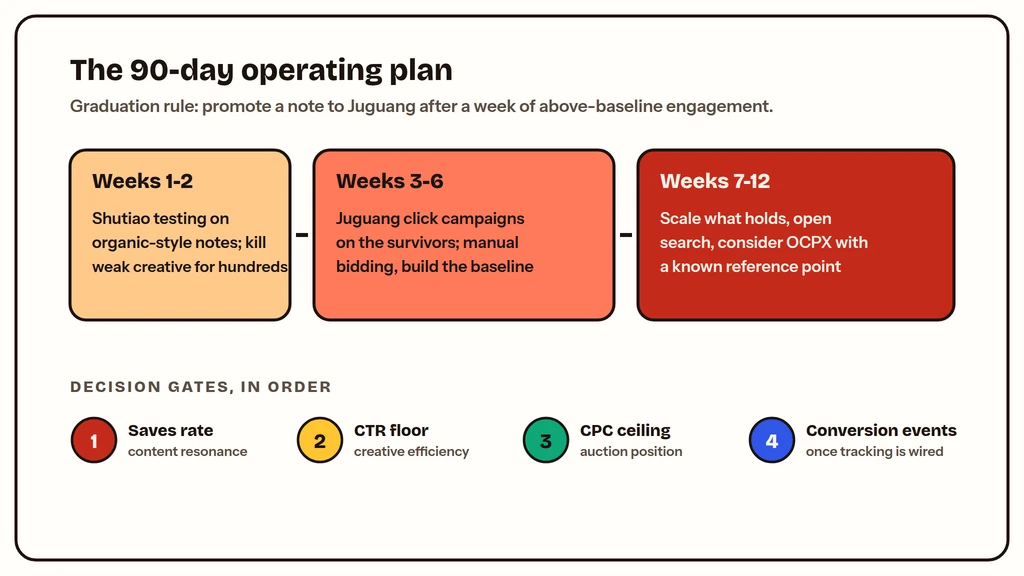
The graduation rule between phases: move a note from Shutiao to Juguang when it holds engagement above your account baseline for a week. The decision gates in order: saves rate first (content resonance), CTR floor second (creative efficiency), CPC ceiling third (auction position), conversion events last (only meaningful once tracking is wired). Brands that skip the boost phase pay Juguang prices for lessons a few hundred RMB of Shutiao would have taught; we've rebuilt enough accounts mid-quarter to consider the sequence non-negotiable.
If you'd rather hand the calendar to a team already running it, that's our RED ads management service, and retainer structures beyond the percentage model live on our agency cost page.
We can help
The honest summary of this page: the rates are the easy part, and the budget discipline (variant minimums, gate order, fee-stack transparency) is what separates a test that teaches from a test that burns. We build these budgets against your category's real medians, run the calendar, and report against the gates. Ask for a costed 90-day plan: media, creative, fees and FX, one number your finance team can approve.
FAQ: buying Xiaohongshu ads
Are ad prices quoted before or after tax?
Confirm per quote: platform figures and agency quotes mix conventions, and the fapiao goes to the China-side entity either way. Make gross-or-net the first line of any comparison sheet.
Can campaigns pause without losing the account balance?
Yes. Pausing stops delivery, and the balance stays on the account for future campaigns; what it doesn't do is refund quickly, so size top-ups to the quarter's plan.
Can overseas brands pay in USD?
Yes, through the licensed processors or a reseller, with conversion to RMB happening in the chain; the spread in the fee stack above is the cost of that convenience.
Does the agency fee include creative production?
Usually not. The 8-12% covers management; production quotes separately per piece. A quote that bundles both should say which variant count it assumes.
How much data before moving from Shutiao to Juguang?
A week of above-baseline engagement per note is our graduation rule. Less than that promotes noise; more than two weeks wastes the winner's momentum.